WE REMEMBER FRUMA AND ALL THE ANONYMOUS VICTIMS OF AUSCHWITZ!

Halina Birenbaum, Auschwitz prisoner nr. 48693, in the palace of the Polish president, upon receipt of the medal: "Krzyz Oficerski Orderu Odrodzenia Polski" from the president Aleksander Kwasniewski, Warsaw 29.9.1999

Halina Birenbaum was chosen to be the "Person of Reconciliation for 2001" 14.03.2001

This year, the Polish Council of Christians and Jews has presented this title to Halina Birenbaum, a Polish-Hebrew novelist living in Israel. This honor is given for merits in the field of Polish-Jewish dialogue.

Halina Birenbaum was born in Warsaw, where, as a child, she lived with the nightmare of the war. In the Majdanek Concentration Camp she spent a night in a gas chamber; in the morning it turned out that the Germans had run out of gas.

She was also a prisoner of Auschwitz-Birkenau.

She survived, though almost all of her family had died. She recounts her memories during meetings with Polish, German, and Jewish youth, building bridges this way between Christians and Jews.

DIALOG: HALINA BIRENBAUM - Człowiek Pojednania 2001

DIALOG: HALINA BIRENBAUM - Reconciliation Person of the Year 2001

January 2003:

New Monograph "My Hundreds of Years in the Holocaust", Polish, English, French & Hebrew

Moje Lata - Wieki w Shoah - Polish

Life as Hope - Complete Translation at Kobos's Web Site "SHOAH"

Life as Hope - English

La Vie Comme l'Espoir - Mes Années - Sičcle de l'Holocauste (French)

The Monograph in Hebrew (Word Document)

Letters to Halina after a Mission to Poland 2004 (Hebrew) אחרי מסע שורשים לפולין  מכתבים להלינה  

Halina Birenbaum: Sounds of a Guilty Silence - Selected Poems

The Holocaust Testimony of Moniek Sieradzki of Lodz

Władysław Szlengel First Posted on Yom Hashoah, Nisan 27, 5763 (29.4.2003) - 60 years later...

"A Dry Notation, and Yet So Much", "Pro Memoria" No. 7 of the Auschwitz-Birkenau State Museum
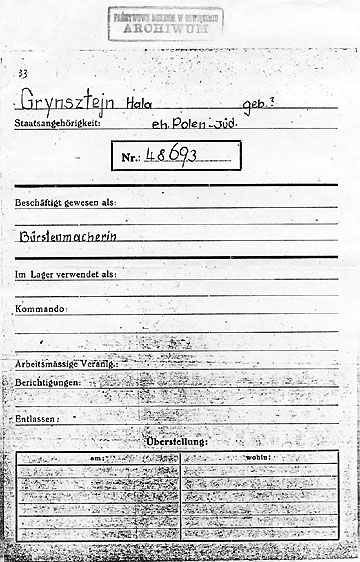
"Among Women on the Edge of Death" , "Pro Memoria" No. 5-6

"Echoes after the Camp" , "Pro Memoria" No. 8

A Note:
The three articles mentioned above are posted after a permission from Auschwitz-Birkenau State Museum was granted A.H. 26.9.2003

"If the World Could Be Thus" - Following the Visit of Pope John Paul II in Israel March 2000

Szalom Chaver

“Jakimi słowami określić wybaczenie”? “In which words to express forgiveness ?” (in Zwoje 34 – Kobos' Web Site)

Cyganie   mojego   dzieciństwa – (The Gypsies of my Childhood) (in Zwoje 36)

Wspólne zwycięstwo tego co ludzkie w nas, z Haliną Birenbaum rozmawia Katarzyna Jekiełek  (Mutual Victory of Humanity within Us - Dialog  between Halina Birenbaum & Katarzyna Jekiełek ) (Zwoje 37)

Bo dobro jest nadzieją – i życiem ( Because Goodness Is Hope and Life) (Zwoje 37)

Henryk... W zamieci wojen (Henryk - from the Storms of War, September 1939 Warsaw Campaign until those of Israel) (Zwoje 37)

חיים בירנבאום: בסערת המלחמות – מספטמבר 1939 עד מערכות ישראל...

Z podróży z izraelską młodzieżą do polski 2003 (A Journey to Poland with Israeli Youth – 2003  (Zwoje 37)

Izrael a Shoah (Israel and the Holocaust - Shoah) (Zwoje 37)

Pragnę wierzyć że to nie jest daremne (I Would Like to Believe That It Is Not in Vain)  (Zwoje 38)

Z mojej podróży na Litwę i do Polski 19. 09. 2000 – 26. 09. 2000 (A Journey to Lithuania and to Poland 19.09.2000 – 26.09.2000)  (Zwoje 38)

Psy w naszym domu (The Dogs in Our House) (Zwoje 38)

"Życzę zdrowia i dobrego humoru   a jeśli nie można, to tym bardziej"  - A Meeting with the Artist and Writer Stefania Grodzienska  (Stefania Ney) (Zwoje 39)

Dzień, w którym wyprowadzili Korczaka (The Day when They Took Janusz Korczak) (Zwoje 40)

 Janusz Korczak – "Pamiętniki z getta (fragmenty)" (Diaries from the Ghetto – paragraphs) (Zwoje 40)  

 Prawda nie jest antysemicka (fragmenty) (The Truth is not Anti-Semitic - paragraphs) (Zwoje 40)

קרול: הבריחה מידי הנאצים


Achmed

Halina Birenbaum's Works in Spanish 

Halina Birenbaum's Works in Portuguese

Yakov Gilad: Ashes and Dust

Selected Poems

Most of the poems are  in Kobos' Web Page "Zwoje" "THE   SCROLLS " An Internet Cultural Periodical  and the Hebrew version in Zchor)

The Pianist (Pol.)

The Pianist (Eng.)

The Pianist (Heb.)

Drzewa milczą (Pol.)

The Trees are Silent (Eng.)

The Trees Are Silent (Heb.)

Mój Ojciec (Pol.)

My Father (Eng.)

My Father (Heb.)

To był tylko początek (Pol.)

It Was Only  the Beginning (Eng.)

It Was Only  the Beginning (Heb.)

Czy mnie widzisz, Mamo? (Pol.)

Mother, Do You See Me? (Eng.)

Mother, Do You See Me? (Heb.)

Mój brat Chilek Grynsztejn (Pol.)

My Brother Hilek (Eng.)

My Brother Hilek (Heb.)

Ona tam czekała (Pol.)

She Waited for Me (Eng.)

She Waited for Me (Heb.)


Po prostu zyc (Pol.)  Just to Live

mnoży się zło The Evil Grows  | czego bać się What to Be Afraid of  | czyje zwycięstwa? To Whom Are the Victories? | w raju fanatyzmu In the Paradise of Fanaticism  |
 dobija bezradność Helpless Blowing Up | pomylona jasność The Mistaken Brightness |
 złe porównanie...
Bad Comparison...


"Poems before and within the Flood" (Hebrew)    Yom Hashoah April 19th, 2004

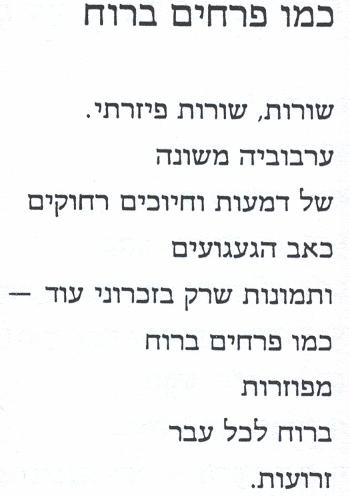
Jak kwiaty na wietrze

Linie po linii rozrzuciłam -
Mieszankę dziwną
Łez i uśmiech
ów dalekich
b
ólu tęsknoty
i obrazy kt
óre są tylko w pamięci jeszcze
jak kwiaty na wietrze
rozproszone
wiatrem na wszystkie strony
rozsiane

Luty 1985, z tomiku „Nawet gdy się śmieję"

Flowers in the wind

Rows by rows I scattered
a strange disorder
of tears and distant smiles
pain and longings
pictures that are still only in my memory -
like flowers in the wind
scattered in the wind
sown in the earth

Translated by Ada Holtzman

Halina Birenbaum - a writer, poet, and translator - born in Poland, was fifteen when the war ended and has been living in Israel since 1946. Her opus vitae "Hope is the last to die" has been published in Poland, Israel, Germany and the United States - fast becoming a classic of holocaust literature. Her volumes of poetry include several titles, originally published in Polish and Hebrew.

The poet can be contacted by email: halina "at" 012.net.il (to avoid spam)

List of Halina Birenbaum's Publications

 "Nadzieja umiera ostatnia" (Hope is the last to die) Czytelnik, Warszawa 1967 (wyd.I), 1988, (wyd.II)

  "Hope is the Last to Die", the State Museum in Oswiecim, 1994

 "Nadzieja umiera ostatnia", POM, Parol, 1996.

 "Hope is the last to die"; Twain Publisher, New York 1971

 "Hope is the Last to Die", M.E. Sharpe Publishing, New York 1996

 "Die Hoffnung Stirbt Zuletzt"(Hope is the last to die) - Reiner Padligur Verlag, Hagen 1989

 "Aufbruch in der Vergangenheit" (Journey into the Past) Ew. Kirche, Berlin 1989

 "Die Hoffenung Stirbt Zulettz", Fischer Taschenbuch Verlag, 1995

 "Ha Haim Ketykvah" ( Life as Hope), Hakibutz Hameuhad, Tel-Aviv 1983

 "Hope is the last to die", Japanese, Tokyo Ushio Company, Tokyo 2000

Closing Section by the Translator Satoshi Kusakabe

 "L' espoir ne meur jamais", (Hope is the last to die) SB.Com.Editeur Paris, 2000

 "Powrót do ziemi praojców",(Back to the land of the Fathers), Czytelnik, 1991.

 "Ruckkehr in das Land die Fater" (Back tthe land of the Father), Fischer Taschenbuch Verlag, Frankfurt 1998

 "Każdy odzyskany dzień" (Every Given Back Day) Znapub.Kraków 1998

 "Wołanie o pamięć" (The Cry for Remembrance) POM, 1999

 "Nigun Pnimi"poems (Inner ) Traklin, Tel Aviv 1985

 "Asher Karati Lemetim" byWladislav Szlengel - Hebrew translation (What I read to the deead), Eked, Tel Aviv 1986

 "Shirim Lifney Wemitoh Hamabul" (Poems before and from time of thflood) own poems and translations Syfryjat Maariv, Tel Aviv 1990
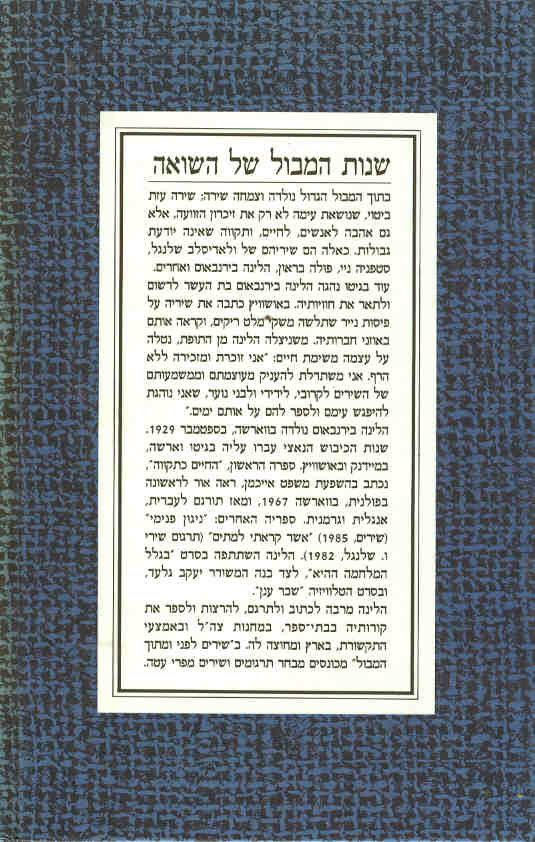
 "Nawet gdy się śmieję" poems (Even when I laugh) KAW, Rzeszów 1990

 "Nie o kwiatach" (Not about flowers) BUS, Kraków 1993

 "Nicht die Blummen Wegen" (Not about flowers) Gildenstern Verlag Bad Honnef 1990

  "Jak można w słowach" poems (How possible in words?) Centrum Dialogu, Kraków-Oświęcim 1995

 "Sounds of the guilty silence", poems, Centrum Dialogu Kraków-Oświęcim 1997

 "Echa dalekie i Bliskie - Spotkania z młodzieżą" ( Znak, POM Karków 2001

 Halina Birenbaum und ich, wiersze i refleksje młodzieży niemieckiej na ich temat, wyd. Books on Demand GmbH ISBN 3-8311-3908-3

Wladyslaw Szlengel 

Mala Stacja Treblinki

Na szlaku Tluszcz-Warszawa,
z dworca Warschau-Ost
wyjezdza sie szynami
i jedzie sie na wprost...

I podroz trwa czasami
piec godzin i trzy cwierci,
a czasami trwa ta jazda
cale zdo smierci...

Astacja jest malenka
i rosna trzy choinki,
i napis jest zwyczajny:
tu stacja Treblinki.

I nie ma nawet kasy
ani bagazowego,
milion nie dostanie
biletu powrotnego...

Nie czeka nikt na stacji
i nikt nie machchustka,
i cisza tylko wisi,
i wita glucha pustka.

I milczy slup stacyjny,
imilcza trzy choinki,
i milczy czarny ,
ze... stacja Tre.

I tylko wisi z d
(reklama w kazdym razi)
zniszczony stary napis:
"Gotujcie na gazie."
                                 ***

A SmallStation Called Treblinka*

By Wladyslaw Szlengel (1914-1943) inGhetto Uprising 1943.

Here is the small station of Treblin
Here is the small station of Trebli
On the line between Tluszcz and Warszawia
From the railway station Warsaw - East
You get out of the station and travel straight
Tjourney lasts five hours and 45 minutes more
And sometthe same journey lasts
A whole life until your death
And the station is very small
Three firtrees grow there
And a regular signboard saying
Here the small station of Treblinka...
Here is the small station of Treblinka...
And no cashier even
Gone is the cargo man
And for a million zloty
You will not get a return ticket
And nobody waits for you in the station
And nobody waves a handkerchief towards you
Only silence hung there in the air
To welcome you in the blind wilderness
And silent is the pillar of the station
And silent are the three firtrees
And silent is the black board
Because here is the small station of Treblinka...
Here is the small station of Treblinka...
And only a commercial board stands still:
"Cook only by gas"
Here is the small station of Treblinka...


* Translated from Polish to Hebrew by Halina Birenbaum and from Hebrew to English by Ada Holtzman. Yehuda Poliker, son of an Auschwitz Holocaust survivor from Thessaloniki wrote music to the poem and it is in his album: "Ashes and Dust".


Halina Birenbaum:

Today is the Birthday of My Brother Hilek

Mój brat Chilek

Dzisiaj są urodziny mojego Brata ale on zginął
w Auschwitz, przed czterdziestu laty,
w selekcji wyznaczony na lewo – na śmierć.
Trudno mi już wierzyć że On w ogóle istniał...
Dwudziestoletniego zabrali go do krematorium.

Ja wtedy byłam małą dziewczynką,
więźniarką w Birkenau.
Ledwie pamiętam jak On wyglądał,
nie mam nawet Jego fotografii!

W moim domu w getcie wszyscy bali się,
że mój los będzie najgorszy,
że mnie pierwszą przeznaczą na śmierć...

Być może mieli rację.
Pod wieloma względami zostałam Tam z nimi.
Pewnym jest, że nie zdążyłam być dzieckiem.
Pokolenia minęłam w straszliwym pędzie,
zmieszałam się z żywymi i martwymi Stamtąd.
Ja – ta mała niezdara rodziny – dziś potrafię żyć,
być Jej godna, czcić Ją,
przekazywać Jej obraz, wymiawiać Jej imię,
pamięć o Nich przekazywać innym.

Dziś mój brat mógłby być ojcem, dziadkiem,
moje dzieci mogłyby mieć wujka...
One nigdy nie widziały twarzy swych bliskich,
ale wiedzą od kogo się wywodzą – i pamiętają!
Może nie daty ich urodzin i kiedy ich zamordowano,
nie pójdą na ich groby, których nie ma nigdzie.
Lecz będą Ich opłakiwać, czcić, przypominać,
ich zasłyszane imiona – zapamiętają.

Mój brat będzie żyć w ich sercach,
W postaciach ich dzieci i dzieci ich dzieci.

To nie to samo!
On został zamordowany młody, w pełni życia.
I tego nie da się zwrócić.

Dziś data Jego urodzin
a Jego tak dawno już nie ma – żadnego po Nim śladu!
Wiatry noszą Jego popioły rozproszone
i będą je rozwiewać
do końca świata i czasu.

Czy mnie wolno podpisywać się nowym imieniem,
istniejącym, żywym?
Czy to jestem ja?
Czy ja kiedyś miałam Brata? Przed tak wielu laty?
Tak wychodzi według dat, liczb dni, miesięcy...
Te wracają co roku, nawiedzają mnie –
Bez Najdroższych.

30.11.1982 – 30. 09. 2003


Halina Birenbaum:

Today is the Birthday of My Brother Hilek
(30 of November 1922 - ? 1943)

Translated by Halina Birenbaum and Ada Holtzman

Today is the birthday of my Brother but He perished
In Auschwitz, 40 years ago, signed by the selection - to the left.
It's hard for me to believe that He was at all...
In the age of twenty, they took Him to the Crematoria, while I was a little girl,
I can hardly remember how He looked,
I don't have even a single picture!

At home in the Ghetto everybody was scared
That my fate will be the worse, destined to die the first...
Maybe they were right -
In many ways I remained there with them
Surly I didn't get to be a child.
I passed generations in a terrible run...
Got mixed there with the livings and the Dead.
Me the little one, the unwieldy of the family - succeed to live today
Deserve to be a part of Her, to cherish Her
To pass Her image, to pronounce Her name
To penetrate Her memory in the others.

My Brother could be a father today, a grandfather.
My kids could have an uncle...
They never saw the faces of their kinsmen!
But they are alive and know from what they were born and grew - they will remember.
Maybe not the dates of birthdays and dates when They were murdered,
Will not go to their graves never dug, graves which do not exist in any place.
But will honor Them, will cry over Them,
Will remember Them! Through the stories and the names
That they have heard, they will remember Them...

My Brother will live in their hearts,
In the images of their children and their grandchildren.
But this is not the same!
He was murdered when so young, in the prime of life
This cannot be returned!!! - Today is His birthday
And He is no more here for so long - no trace was left.
And winds will blow His scattered ashes
Until the end of world!...

Is it proper that I sign my other name, which exists and lives?
Is it me?
Did I have Him? Had I a Brother once?! So many years ago...
So it seems according to the dates, the numbers of the days, the months...
They come back year by year, appear
Without the dearest.

30.11.1982

My Brother Hilek (at Kobos Web Site: "Poems of the Holocaust")


Fruma

Imię
tak dawno nie wymawiane
wygrzebane przypadkiem
ze świata popiołów
w otchłpamięci

Wychud
twarz przezroczysta blada
skulona przy mnie pod kocem
na narze w bloku 27
dwa tygodnpo tyfusowej (1
opowiada
zatopiona w drogich obrazach
o domu o matce
o przysmakach jakie jadała


grzeję się ciepłem jej ciało
wyobraźnią o jej domu
w Sosnowcu nieznanym
o tych fantastycznych przysmakach
byłam dłużej w obozie choć młodsza
mnie zawlekli do Birkenau
z getta Warszaw
z komory gazowej Majdanka
wzajemnie wspierałyśmy się

na bloku
hałas tłum więźniarek ruchliwy
tego dnia w Auschwitz mgła nieprzenikniona
ziąb straszliwy - niebyła szansa
komanda nie idą do pracy
można wrócić na koje
uśpić głód marzyć o szczęśliwej
przeszłości

wtem kapo w drzwiach
zgiełk się wzmaga napięcie
wywołują numery
my w opowiadaniu Frumy oderwane
chyba bioą kogoś do pracy
czy na jakieś kary
tyle kobiet na bloku
nie zwracamy uwagi

cisza
po kolejnym wywołanym numerze
powtórzone z wściekłością wołanie
przerywa wpół zdania
milknie
zeskoczyła z nary
przy drzwiach się rozebrała
owiniętą wszorstki koc
pognali w grupie wybranych
do gazu

pod kocem
jeszcze ciepło jej ciała
w uszach głos wzruszony o dom
o matce o matczynym jedzeniu
za barakiem przed oczami
gęsty czarny dym z wkomina

miała 16 lat i delikatną bladą twarz
cichą dobroć ludzką w tym piekle na ziemi
i tyle z niej pozostało we mnie
na zawsze

Halina Birenbaum 5.07.1994

פרומה

שם

זמן רב כל כך לא נאמר

הוצא באקראי

מעולם האפר

במפולת הזיכרון


רזה

פניה שקופות חיוורות

מקופלת לידי מתחת לשמיכה

על הדרגש בבלוק 27

שבועיים לאחר סלקצית הטיפוס   (1

היא מספרת

טבועה בתמונות יקרות

על הבית על אימא

על המטעמים שנהגה להכין


אני מקשיבה

מתחממת בחום גופה

בדמיונות על ביתה

בעיר סוסנוביץ הלא מוכרת לי

על אותם מטעמים מופלאים של אימה

אני יותר זמן במחנה למרות שצעירה ממנה

הובלתי מגיטו ורשה

מתא הגז במאידנק

התיידדנו כאן


בבלוק

רעש המון אסירות פעלתניות

היום ערפל סמיך מעל אושוויץ

קור אימים - סיכוי בלתי רגיל

הקומנדו לא יוצאים לעבודה

אפשר לחזור לדרגשים

להרדים הרעב לחלום על העבר המאושר


לפתע

קאפו בפתח הדלת

מהומה גוברת מתח

קוראים מספרים

אנחנו בסיפור של פרומה

בטח לוקחים אי אלה לעבודה

לביצוע עונש

נשים רבות בבלוק הרי

לא מקשיבות


דממה

לאחר שם הבא בתור

קריאה נוספת נוקשה מחרידה

המילים קופאות על השפתיים

היא מתאבנת

וקופצת מהדרגש                                                              

התפשטה ליד הדלת

נלקחה בקבוצת הממוינות - לגז


מתחת לשמיכה

עדיין חום גופה

באוזני קולה הנרגש

מלים על בית על אימא על אוכל

בפני עיני

מאחורי הבלוק

עשן שחור סמיך מארובה ענקית                                  


הייתה בת שש עשרה

פניה עדינות חיוורות שקטה

חדורה טוב אנושי בתופת  הזו

אני נושאת אותה בתוכי                                

תמיד

                          הלינה בירנבאום      5.06.1994     


1) W okresepidemii tyfusu w Birkenau jesienią 1943 r. odbywały się częste selekcje, podczas których nie rozbierano się do naga. Badano jedynie języki - biały język stanowił wyrok do gazu. Na opisanej wyżej selekcji nie odprowadzano do komór gazowych jak zwykle, tylko coś zaznaczano obok numerów poszczególnych
więźniarek.
Po dwóch tygodniach dopiero wywołano numery tych kobiet podczas blokady w obozie i rozebrane zawleczono je na śmierć. H.B.

Fruma

a name
long not mentioned
by chance scooped out
from the world of ashes
from the gap of memories

emaciated
transparent pale face
curled up near me under a blanket
on a bank in 27th block
two weeks after typhoid selection (1
speaking
absorbed in lovely scenes
about her home about mother
about delicacies which she once ate

I listen
warming myself with her body's warmth
imagining her home
in the unknown town of
Sosnowiec
about the fantastic delicacies
though I was younger, I'd been longer in the camp
they dragged me to Birkenau
from the Warsaw Ghetto
and from the gas chamber in Majdanek
we mutually supported each other

ith
a noisy crowd of active prisoners
today there was a dense fog in Auschwitz
awful chill uncommon
the command - nobody works today
we can return to our bunks
put to sleep hunger and daydreams about the happy past

all of sudden
a capo at the door
turmoil grows tension
calling out numbers
we were lost in Fruma's tale
maybe they are taking somebody to work
or somebody is being punished
with so many women on the block
we don't pay attention

silence
after the next number is called
furious repeated calls
stopping at half sentence
silently
jumps of the bunk
near the door she took off her clothes
covering herself with a gray rough blanket
chased in the group of the selected
to the gas

under the blanket
still warm her body
sounds of touching voice about home
about mother's cooking
before the eyes behind the barrack
dense smoke from a huge chimney

she was 16 years old and had a delicate pale face
quiet human kindness in this hell on earth
and so much was left of her in me
forever

Halina Birenbaum July 5, 1994
Translated from Polish by June Friedman

 1) At the time when in the fall of 1943 was a typhoid epidemic there were often selections but there was no need to take off clothes till naked. They used to lock at the tongue. A with tongue was a verdict for gas. On the described selection nobody was taken to the gas chamber as usual, but they marked something near the number of an individual prisoners. After two weeks they called numbers of women during a blockade in the camp and dragged them undressed to their death. H.B.


Contact Halina Birenbaum: halina "at" 012.net.il (replace "at" with @ to avoid spam).


Halina & Chaim Birenbaum on their 50th wedding anniversary

Last Updated August 30th, 2004