We Remember the
Synagogues!
Moshe Verbin:
Wooden
Synagogues of

The Synagogue of Wilkowishki,
a village in Lithuania
with the drawings of the Khodorov ceiling in the background
|
Moshe Verbin wishes to thank the important
and famous architects and researchers: Maria and Kazimierz Piechotka
from They taught him, assisted him and supplied
him with the necessary material. They should be highly commended by the
Jewish people as since the end of the War, they gather every piece of
precious information about the destroyed wooden Synagogues, aiming to
preserve their memory. Their blessed arduous work produced two
most valuable albums. The first one is about the wooden synagogues: Maria & Kazimierz Piechotka: Wooden Synagogues,
The second album, recently published is
about the built synagogues in the main towns of |
|
David Dawidowicz: Synagogues in Poland and their Destruction |
|
Important Announcement The
exhibition of Moshe Verbin' models of the destroyed wooden synagogues of
Poland in the 17th and 18th Century, is now on a permanent display at
"ORT" College in Givat Ram Jerusalem, Israel. The models and the
documentation about each synagogue are in two display windows in the main
corridor of the college, which is situated on the right side of the entrance
to the Hebrew university. The address is: Givat Ram Telephone: 02-6754602 |

Members of the Exhibition's Public
Committee in 1990:
Jair Tsaban Member of Knesset
Avner Shalev Director of Administration and Art in the Ministry of Education
& Culture
Prof. Hana Shmeruk, Chairman of the Centre of Research of Polish Jewry
Zussia Ephron, Researcher of Jewish Art
Dr. Baruch Gitlis, Harry Karren Institute
Yoav Dagon, Director of the Herzliya Museum
Second Edition -
With the help of "Bank
Tphachot" and Kibbutz Yakum
Our gratitude to Mr. Haim Kovarsky - Chairman
of the Council of the Bank.
Design: Roni Kourtz
Photography: Moshe Cohen-Wollin
Translation: Ruth Paz, Sindi Komet, Arie Jafe (Kibbutz Yakum).
Catalogue production: Cohen Rokah
All rights reserved by Moshe Verbin and the
Herzliya Museum.
April 1990
April 1992
This Web Site was made possible after having received a written
permission from Moshe Verbin!
Copyright (C) Moshe Verbin and the
Hertzelya Museum
All rights reserved
This
material can be used for educational and research purpose only, and is fully
copyrighted!
The Catalogues are for sale in Beth
Hatefutsoth, Tel Aviv Israel
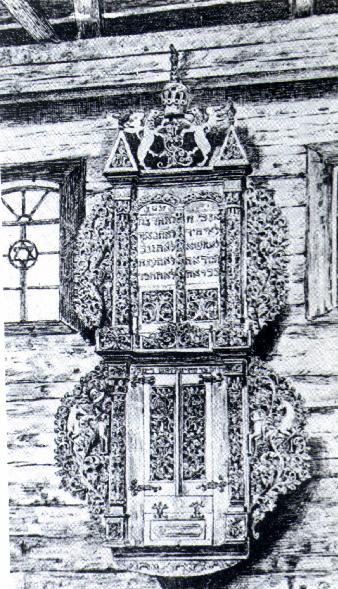
Uzlany, a small town in the area
of Minsk, Belarus: The Holy Ark.
The upper part (with the holy tables of the Decalogue) survived and is found in
the National Museum of Minsk. It was discovered and photographed by the
researcher Zussia Ephron.
Wooden
Synagogues in Poland
Magnificent Architectural
Creations
By Maria and Kazimierz Piechotka,
Warszawa
The first Jews to immigrate to Poland arrived in the 12th century, and in the 15th C. They came in masses. They were refugees, fleeing from persecution in Western Europe, mainly from German and Czechoslovakia. Their conditions of life in the Diaspora prevented the evolution of their own building traditions. Only the protected life on Polish soil enabled the Jews to create synagogues adapted to Jewish religious needs. Following the prescriptions of Talmudic scholars. This evolution took place between the middle of the 6th and the 17th centuries, during the era called the "Golden Century of Polish Jewry". At this time the Republic of Poland and Lithuania, encompassing the territories of ancient Poland, Lithuania, Belarus and Ukraine, harbored the biggest Jewish Community of those times. The principles of planning the prayer- halls, with a "Bima" built in its midst, were followed in Polish synagogues until the 19th century, and influenced the shape of many synagogues, in stone and in wood, dissimilar to those built in other countries.
In Poland, a country abounding with forests, wood was a building material used everywhere, for secular uses, but also in the religious realm of prayer-houses of all denominations. The woodcraft was of a high quality. Due to the deterioration of the natural, numerous fires and war destruction, the oldest wooden synagogues known to us from preserved descriptions, originate only from the middle of the 17th century.
Many of those synagogues, among them some most impressive, were built in little villages during the second half of the 18th Century, using forms and constructions characteristic to the Polish wooden architecture. This included multi-layered high roofs, multi-beamed domes, galleries, wooden balconies and arches.
The wooden synagogues were outstanding in the surroundings due to the shape of their roofs whose structure encompassed the relatively large prayer halls. These halls contained luxurious arches whose shape sometimes resembled the "Tent of Congregation".
An interesting detail in these buildings was the inclusion of a loft facing the hall, which was planned as one architectural structure. The flexibility of wood made this easier than any other building material.
Especially interesting was the construction of the roofs, which leaned on the rims of the walls. The rim coverings, with the help of boards, produced concave interiors and convex exteriors, which surrounded the entire structure.
Jewish religious needs were expressed by using the forms of art, evolving in the Republic of Poland. The mutual cultural influences between the two peoples, living one alongside the other during several centuries, found their expression in the architecture of the synagogues. Those wooden synagogues were also the highest achievement of baroque architecture, even in European dimensions. To our great grief, not one of those survived, even though many of them still existed until the beginning of W.W.II.
All those synagogues in the territories occupied by the Germans and the Soviet Union were destroyed without any exemption. Luckily, many photographs and pictures remain, giving us a description of the wooden synagogues.
Moshe Verbin, a pioneer of the Kibbutz movement and one of the founders of Kibbutz Yakum, arrived in Israel before W.W.II. He was very young, but he brought with him the memory of those unusual buildings. When he received our book on Wooden Synagogues of Poland, in the sixties, he felt their fascination again with renewed impact. He decided to use the published photographs and pictures to rebuild those impressive buildings. His aim was to revive the synagogues in the memory of those Jews, and even non-Jews, who arrived from ancient Poland, and to present them to those, who did not know them at all.
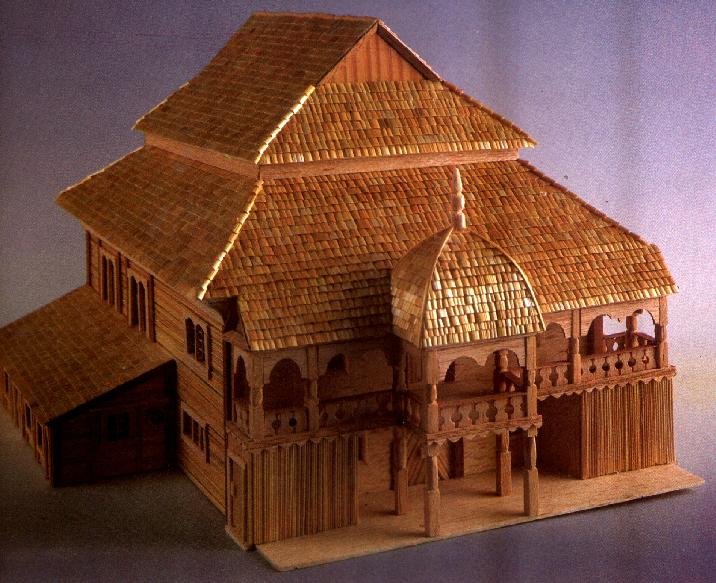
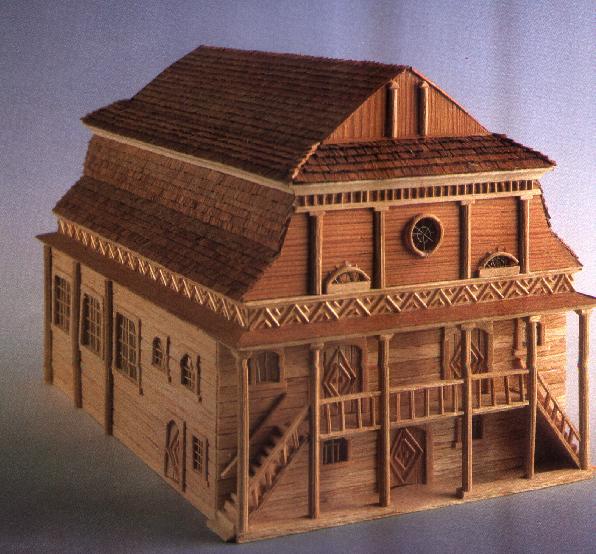
Verbin creates his miniature models from bits of wood and straw, with dexterity and precision. He has devoted more than twenty years to work, all ohis spare time left after professional and public activities. He builds with all his heart. Not only does he recreate the external form of the synagogues, perceived from books, a task limited by scale and material, but he also collects the specialized books and photographs with passion, searching in libraries and archives. He diversifies the expositions of his models by adding photographs of the interior of those synagogues.
Their impressive vaults, and the "Aronot Hakodesh", "Bimas" and polychromes, were creations of Jewish masters, who called them "Sacred Works".

Gombin, a small town west of
Wooden
Synagogues
an Expression of Jewish Folk Art
By Zussia Ephron, Jewish Art Historian
The golden age of Jewish art on Polish soil began in the 15th century, but the beginof this creativity is already to be found at the end of the 16th century. This artistic activity was expressed primarily of synagogues (architecture), and in their ornamentation in various techniques, including interior paintings, woodcarvings, stone fittings and sculpting (primarily of tombstones). Beside these activities connected with building, there was also a developed Jewish art in everything connected with the ornamentation of Arab scrolls. Among the famous objects were crowns, platters, handles, pomegranate handle-tops, memorial lamps and light-reflectors. In effect, all served for everyday use in the synagogue provided a broad range of acfor the Jewish artist in Poland.
The synagogues, because of their size, constituted a particular challenge.
They sere impressive wooden buildings which rose above the houses in the
villages. Their roofs had two, three, and sometimes four slopes standing one on
top of the other and creating an interesting architectural effect, one that
historians call "the style of the wooden synagogues of Eastern
Europe".
The ornamentation in the synagogues was of different kinds, including painting of animals, among them lions, griffins and unicorns, and also birds, all interwoven in a continuous stylized paintings of plants and bibli. The dominant colors in the ornamentations were strong red, green, blue and orange, and black for the inscriptions. The paintings spread across the ceilings and the walls and wherever they could be fitted in.
The Ark of the Torah, the platform, the prayer-pillar, were the work of the carvers in wood. Some of the carvings were painted in strong colors, and among the typical forms was the eagle, which was also the symbol of Poland. Beside these there was also the embroidery work on the cover and curtains of the Holy Ark.
During the massacres of 1648-49 many of the Jewish communities in Poland were destroyed by the Cossack hordes under Chmielnicki, and hundreds of synagogues were burned. When the pogroms subsided the Jewish communities rehabilitated themselves and erected new synagogues, and during the period between the two world wars some 100 wooden synagogues were still standing, some of them architectural masterpieces, among them those in Jurborg, Wolpa, Narowla. During the Holocaust the Nazis and their accomplices destroyed the last of these synagogues, and today no trace of them remains.
Moshe Verbin's reconstructions are a great contribution to the reviving of the memory of these synagogues. The models he has built with such faithfulness to the originals, based on scientific sources, are a work of art in their own right. He began this work 27 years ago and he is still continuing the project.

Khodorov, A
small town in the
Moshe Verbin of blessed memory

Moshe and Mira
Verbin, Kibbutz Yakum, Summer 2000
The artist who builds these samples was born in 1920 in Sokolka (
Moshe Verbin relates that he immigrated to Eretz Israel according to the request of relatives, believing that his parents and two young brothers will follow him. To his deep grief it did not happen as wished and the War caught them in their small hometown Sokolka. On January 26th , 1943 they weer expelled to Auschwitz and murdered on the spot. From all my family (bearing the name "Verbin") in Poland and France, no one survived!
M. Verbin "discovered" the wooden synagogues of the early Poland, when he found a book which was published by the Piechotkas (Warsaw 1957) about these synagogues. The book is a collection of photographs and drawings of these antique synagogues made of wood, which were used for prayers and all other needs of the Jewish community, and were found in all the little towns of Poland. In this book Moshe Verbin found an almost unknown treasure of the Jewish Art and Culture.
The thing that conquered Moshe's heart is the fact that most of those wooden buildings were planned constructed and designed by Jewish craftsmen. That is why the Russian explorer G. Lukomski defined them as the " Jewish Folklore Creativity".
Moshe Verbin has been reconstructing these synagogues (Scale: 1:100) in order to bring their story to the Israeli public in this way. Since the Jews chose wood, which was affluent in the surrounding, and was the cheapest material to be used, M. Verbin has chosen straw which is affluent around his house and home, for the building of these samples.
The wandering exhibition o Moshe Verbin was held 18(!) times in various museums, galleries and instututions in Israel. Whereever it was held, it was very successful and rose lot of interest. But still, until today, there was not found a place to keep it permenantly, as a project of commemoration the popular Jewish creation.
The sources of the photographs on the exhibition and the catalogue are from:
M. Berson
E. Breier
A. Grotte
M & K. Piechotka
H. Shtruk
A. Szyszko-Bohusz
I. Zajczyk
David Dawidowicz: Synagogues in Poland and their Destruction
Synagogues
in the Catalogue
|
|
Town |
|
Country today |
Coordinates |
Distance |
|
|
|
Ukraine |
49°27' 24°09' |
468.1 kilometers W of Kiev |
|
|
|
|
Poland |
52°24' 19°44' |
87.6 kilometers WNW of Warsaw |
|
|
|
|
Belarus |
53°41' 23°50' |
246.2 kilometers W of Minsk |
|
|
|
|
Ukraine |
48°35' 25°17' |
429.8 kilometers WSW of Kiev |
|
|
|
|
Ukraine |
48°24' 24°57' |
461.3 kilometers WSW of Kiev |
|
|
|
|
Poland |
53°28' 23°14' |
201.8 kilometers NE of Warsaw |
|
|
|
|
Lithuania |
55°04' 22°46' |
168.kilometers WNW of Vilnius |
|
|
|
|
Ukraine |
50°06' 24°21' |
439.5 kilometers W of Kiev |
|
|
|
|
Ukraine |
49°24' 24°19' |
56 km SE of L'viv. |
|
|
|
|
Poland |
51°12' 20°25' |
123.4 kilometers SSW of Warsaw |
|
|
|
|
Poland |
52°15' 17°06' |
265.3 kilomeW of Warsaw |
|
|
|
|
Poland |
51°45' 19°13' |
134.1 kilometers WSW of Warsaw |
|
|
|
|
Belarus |
51°48' 29°30' |
267.0 kilometers SSE of Minsk |
|
|
|
|
Poland |
52°35' 20°48' |
39.4 kilometers NNW of Warsaw |
|
|
|
|
Belarus |
53°24' 23°46' |
256.3 kilometers W of Minsk |
|
|
|
Olkeniki |
|
Lithuania |
54°21' 24°50' |
48.4 kilometers SW of Vilnius |
|
|
|
Ukraine |
48°31' 24°54' |
457.9 kilometers WSW of Kiev |
|
|
|
|
Ukraine |
49°29' 29°16' |
138.3 kilometers SW of Kiev |
|
|
|
|
Poland |
51°05' 19°53' |
150.8 kilometers SSW of Warsaw |
|
|
|
|
Lithuania |
55°25' 24°17' |
104.7 kilometers NW of Vilnius |
|
|
|
|
Poland |
52°31' 20°39' |
110.1 kilometers NE of Warsaw |
|
|
|
|
Poland |
53°35' 23°06' |
204.3 kilometers NE of Warsaw |
|
|
|
|
Belarus |
53°37' 27°43' |
33.0 kilometers SSE of Minsk |
|
|
|
|
Poland |
51°47' 21°12' |
53.6 kilomSSE of Warsaw |
|
|
|
|
Belarus |
53°22' 24°22' |
219.0 kilometers WSW ofMinsk |
|
|
|
|
Poland |
52°55' 22°31' |
126.4 kilometers NE of Warsaw |
|
|
|
|
Lithuania |
54°39' 23°02' |
146.8 kilometers W of Vilnius |
|
|
|
|
Poland |
53°01' 23° 21' |
79.9 kilometers ENE of Warsaw |






Last updated August 4th, 2010 – first posted in July 2000