WORLD
COMMITTEE
IRGUN YOTZEY PLOTZK
for
the
BE-ISRAEL
PLOTZK MEMORIAL
BOOK
(Plotzker Association in
PLOTZK
(
A HISTORY OF AN ANCIENT JEWISH COMMUNITY IN
Editor:
ELIYAHU EISENBERG
Vice-Chairman,
Plotzker Association in
"HAMENORA"
Publishing
House
Tel-Aviv,
1967
The Yizkor Book
in MS Word File Format 
The Yizkor Book
in MS Acrobat Format

Notes
The English part is not a
complete translation of the Yizkor book of
I have translated and added the titles and page numbers of articles which do not appear in the English summary. I added the code "H" if article is in Hebrew, or "Y" if in Yiddish.
I have added also the sub-chapters to the various articles, which are not included in the original Table of Contents. On many occasions I have added from the Hebrew and Yiddish parts of the book also names of people mentioned in the articles, when that was possible, mainly in the Holocaust chapters.
I have also added the names of people who appear in the photographs to the captions in English which did not include these names, see pages
I wish to thank the Płock Landsmanschaft who encouraged me and gave me and JewishGen the permission to post the Płock Yizkor book in the Internet.
It is my hope that this book will serve as commemoration
to the Jewish ancient grand and holy community of
|
|
Page |
||
|
|
5 |
||
|
|
|||
|
HISTORY OF THE JEWS IN PLOTZK UNTIL THE FIRST WORLD
WAR |
|||
|
|
|||
|
History of the Jews of Plotzk
from the Middle Ages until the 17th Century Foreword Jewish trade Legal status of Jews Taxes Communal ("Kehila") Organization Jewish patens of life Blood libels Jewish-Christian Relations Prominent Kehila personalities Non-resident Jews Conclusion |
Y. Trunk |
10 |
|
|
The History of the Jews of Plotzk
from the Middle of the 17th Century until World War I
|
Y. Trunk |
16 |
|
|
Dr. Y. Schipper |
25 |
||
|
Dr. E. Ringelblum |
25 |
||
|
The Privileges of the Jews in Plock |
Michael Szperling |
H-74 |
|
|
E.E. |
25 |
||
|
Avraham Yaacov Papierna
(1840-1919); a Teacher and Literary Critic |
S. Greenspan |
26 |
|
|
E. Eisenberg |
27 |
||
|
R' Yehuda Leib Margoulis R' Zysza Plotzker R' Shmuel Ben Azriel R' Arye Leib Zunz (Reb Leibele Charif) R' Abraham of Ciechanow – the Plotzker "Ilui" R' Yissachar Dov Graubart – N. Sokolov's Rabbi R' Eleazar Cohen R' Azriel Arye Leib Rakowski, the fighting "mitnaged" |
S. Greenspan |
28 |
|
|
Jewish Life in Plotzk in the light of
Hebrew Periodicals of the Second Half of the19th Century Itzhak Grinbaum and Aharon Becker - pillars of Zionism in Plotzk The pre-Zionist epoch of Nahum Sokolov Education and cultural life Public institutions and social work Relations with Polish neighbors Emigration |
S. Greenspan |
33 |
|
|
F. Sokolov |
36 |
||
|
Płock Hassidim and Nahum Sokolov |
Kurt Blumenfeld |
H-130 |
|
|
Fragments of Memories |
I. Grinbaum |
H-131 |
|
|
I. Grinbaum |
36 |
||
|
Y. M. Zlotnik |
37 |
||
|
Gerer Hassidim The Beth Midrash Spirit of progress Rabbi R' Yecheskel Lipszyc Family Kampner "Amcha" near the "Iron Gate" |
S. Rozen |
37 |
|
|
Memories of a pupil of the Russian Gymnasium 10% only to the children of the Jews In the school of the teacher Jarzombek The problems of the Jewish pupils; the teacher of religion: A. J. Papierna |
Jakob Brozda |
H-141 |
|
|
The value "Płock" in various
encyclopedias |
|
H-145 |
|
|
A Jewish settlement from the 11th century is discovered |
|
H-145 |
|
|
I. Tynski |
38 |
||
|
|
|||
Page 5-8
It is with a feeling of deep respect and in a spirit of awe that we present the remnants of the Plotzk Jewish community and the Jewish public at large with this memorial volume. After collecting and editing a large amount of material over a period of five years, we now have the honor of putting the fruit of our endeavors into your hands. Whilst we, who have been engaged in this work, express our satisfaction that we were privileged to see it in its final form, we should nevertheless note that we did not succeed in bringing to light a number of chapters and happenings in the history of our community, which should have found their place in this book. Some events and personalities may also not have been fully or suitably reported or described since relevant information about them was not available.
We should therefore like to ask for the indulgence of all former Plotzk Jews, wherever they may be, in whose hearts the memory of their community is alive, as well as of all those, who engage in the study of Jewish history and are familiar with the history of our ancient community, and of thousands of other Jews, who are tied by family bounds or various memories to Plotzk. They will, we pray, regard our efforts in a favorable light, aware, as they surely are, that the flames of the holocaust fire have consumed much which can no more be reconstructed. In spite of these limitations, whatever we did was done in order to honor the sacred memory of our whole community; all its sons and daughters without exception. The whole community of ten thousand Jews, who lived there until the outbreak of the Second World War and who, - but for about 300 souls who survived, - all perished by fire and sword, by hunger and thirst, by epidemics and strangulation, through the hands of human beasties, the Nazi-criminals and their assistants. All of them, men, women and children, intellectuals and ordinary folk, rich and poor, all without difference of their ideologies or affiliation - are holy martyrs in our eyes and in the eyes of the whole people of Israel and hence entitled to an equal measure of honor and commemoration.
To honor the memory of our martyrs was the guiding light of our work. At the same time we saw to it that this book should not turn into a collection of family or individual memorial notations, but rather portray the whole Plotzk Jewish community throughout the ages, its struggles and achievements, its failures and successes, its greatness and final destruction. Descriptions of individual lives were included in this book only in as much as they contributed to an understanding of their period or reflected various trends of public life, or if the personalities portrayed led the community in one sphere or another.
For lack of reliable source-material it was virtually impossible to describe chronologically and pragmatically the history and activities of many of the communal institutions and public organizations in all their various facets of life. We therefore decided to append a biographical index of personalities, who were active for the common weal. Although we called several times upon ex-Plotzk people all over the world to let us have relevant background material on the lives and deeds of men and women who should be recorded in this index, we did not succeed in compiling a complete index, nor in some cases gather full details concerning individuals. The quantity of material in any item should therefore not be regarded as an indication of the respective person's importance and role in the community.
The same goes for the Yizkor-list in this book. We know only too well that it is virtually impossible to compile a complete name-list of our ten thousand brothers and sisters, who found their tragic death during the Second World War, since whole families were annihilated without any remaining survivors. Nevertheless we did our very best to collect over the years all available names of our martyrs through appeals to Plotzk survivors everywhere, so that they should at least find in the book some sign of their beloved ones who are no more. In the end only 2640 names were brought to our knowledge and among them many names of persons who were not residents of Plotzk before the war.
*
The editors of this volume are conscious of the fact that they are but treading in the footsteps of their predecessors, who endeavored to secure Plotzk its rightful place in the annals of Jewish history. This aim found its practical expression in the activities of the committee set up as long ago as 1937 to commemorate 700 years of Jewish life in Plotzk, which culminated in the book published by Yeshaya Trunk in 1939. The present volume contains an abridged version of Mr. Trunk's work (which never reached the public because of the war), and includes as well the second part of the historical research compiled by the writer at the special request of the editorial board. We are convinced that the fruits of his labor are of great historical, social and cultural importance not only to Jews who hail from Plotzk, but to all those interested in the history of Polish Jewry.
Efforts by Plotzk Jews to commemorate their community in the form of a book were made immediately after the conclusion of the war. The first ones to bring out a memorial volume ("Plotzk, Blettlech Geschichte", Buenos Aires, 1945, 260 pp.) were the Plotzker Association in the Argentine. Dr. Jacob Shatzki in his lengthy review ("Yivo Bletter, Vol.27, 1946") praises their sincere efforts to commemorate the community in this way, but states that the need for a fully documented work on Jewish Plotzk still exists. Dr. Shatzki's evaluation and especially the extensive bibliographical list, which followed his article, undoubtedly contributed to the work of Shlomo Greenspan, of blessed memory, ("Yidn in Plotzk", New York, 1960, 328 pp.) which, although not constituting an all-encompassing review of the community, comes close to being a pure historical work of research. This book was verve favorably received by various reviewers in the U.S. A. and in Europe. S. Greenspan was regarded during recent years as the expert on the past of Jewish Plotzk. He left no stone unturned in order to reveal details of its history during the ages, and published many of his finds in the American Yiddish press. Devoid of the necessary financial means to bring out a full-fledged issue of his work, he devoted all his efforts to aid us in editing this book. The series of his articles on the great Rabbis of Plotzk, on A. 3. Papierna and especially his painstaking work collecting articles about Plotzk, which had appeared in the Hebrew press in the second part of the 19-th century, as well as the appr. 120 items of the biographical index which he edited, are evidence of the important contribution he made to the commemoration of our community. It should also be noted that he made available to us a great deal of material on the last period in the community's life and on the years of its destruction. This book, and especially its first part, would not have been the same without the collaboration of Shlomo Greenspan. We deeply mourn his untimely death and the fact that he did not live to see this work coming off the printing press.
Great emphasis was put on editing the third and last part of this volume, which describes the period of the Nazi-holocaust. The agony of our hearts was poured into the writing of this chapter, but in order to give an objective and true description of that terrible time, we introduce it by a historical review, specially written by one of the best known authorities on the holocaust, Dr. Joseph Kermish.
Letters written by Plotzkers in exile, which were contained in the Ringelblum archives found in the Warsaw ghetto, are being published here for the first time. The last cries of our martyrs call to us from these pages...
Over 260 photos were selected from a wealth of pictorial material sent to us from many corners of the world. After screening them carefully, we believe that we have produced a Kaleidoscope of Plotzk Jewish institutions and organizations.
*
The editors endeavored to give this book an aesthetic form and although this increased the cost of production, nothing was spared to create an impressive and suitable memorial volume. The assistance extended in this respect by the Plotzk-born painter Jacob Guterman, who adorned the book with his masterful drawings and illustrations cannot be appreciated enough.
The editorial board wishes to express its gratitude to all those who helped the work along in its various stages and who did their part with great devotion and full responsibility.
Mr. Adam Rutkowski of the Jewish Historical Institute in Warsaw sorted and edited letters from the Ringelblum archives. He also choose for publication important historical material from the Plotzk Municipal protocols, but unfortunately these papers have not been received and could therefore not be included in this book. Mr. Zwi Yashiv, journalist and editor, corrected Hebrew and Yiddish texts and prepared the English synopsis. His professional advice was of value in editing this book. Mr. Abraham Frank inspected the English summaries and edited the English part of the book. Mr. Mordechai Sonschein, the publisher, showed great patience and understanding for the technical problems connected with the publication.
Last but not least: The accuracy and devotion with which the Printing-House "Arazi" Ltd. of Tel Aviv printed this book is most commendable.
We extend our sincere appreciation and gratitude to all authors of the articles, essays and reviews published in this book.
Thanks are also expressed to all those who sent us letters, written material and photos and to all our friends in Israel and abroad, who spared neither time, effort nor money to enable us to publish this book.
May they all be blessed, and derive satisfaction from their labor upon holding this volume in their hands and seeing that the work has been completed. We conclude with the words of the Psalmist (139, 36):
"And in Thy book they were all written ..."
*
We express our sincere gratitude to our esteemed friend, Itzhak Grinbaum, who honored us by serving as Honorary President of the World Committee for the publication of this book.
The Editorial Board
HISTORY OF THE
JEWS IN PLOTZK UNTIL THE FIRST WORLD WAR
(1237 - 1914)
Page 10-15
HISTORY OF THE
JEWS OF PLOTZK FROM THE MIDDLEAGES UNTIL THE 17 TH CENTURY (1237-1657)
(SUMMARY OF THE BOOK "HISTORY OF THE JEWS
OF PLOTZK" BY YESHAYA TRUNK - PUBLISHED 1939)
FOREWORD
The Jewish community of Plotzk is considered, together with those of Kalish and Poznan, as one of the oldest in Poland. We have reason to believe that there were Jewish inhabitants in Plotzk prior to 1237.
In the years 1919-1939 (between the two world wars), Polish Jewry was engaged in a fight against official and unofficial anti-Semitic activities and legislation. It was then that proof was sought for the fact that the Jewish "Kehila" (community) of Plotzk was one of the oldest in that country, in order to refute thereby our enemies claims that the Jews were aliens on Polish Soil. A special jubilee committee was established for that purpose, composed of historians and other prominent personalities. The first part of a book, written in Yiddish, by Yeshaya Trunk M. A. on the history of the Jews of Plotzk was published by it in January 1939. This publication was, unfortunately, lost during the war years and only a few copies remained extant. Its contents form the basis of the article, of which the following is a summary in English.
*
The first information about Jews in Plotzk dates back to the year 1237. No evidence of Jewish life in this town is available for almost two hundred years after that date. In 1425 - we are told by historical documents - a certain Misterlin, a Jew of Plotzk, appeared before a Court in a civil case. We learn that a Jewish community existed in Plotzk already in the 15th century from the fact that a rabbi held office there and that taxes due from the Jews were transferred from one Count to another. Their legal and political status changed as a result of the incorporation by the Polish Crown of the Principality of Mazovia (where Plotzk is situated). In the course of the 16th and the first half of the 17th centuries the Jewish community continued to grow, whilst many other important Jewish communities vanished, as a result of deportations of Jews caused by anti-Jewish legislation by the Polish rulers.
An inventory list of 1572 states that "the Jews occupy one whole street of Plotzk and several houses in other streets". Another inventory mentions 25 Jewish houses there. Knowing the density of urban population in those times, we may assume the number of Jews to have then reached five hundred.
JEWISH TRADE
The town of Plotzk, on the banks of the Vistula River, served as an important trading center. Its merchants maintained commercial contacts with those of Gdansk (an important port on the Baltic Sea), and of other Polish and German cities. The Jews played an important role in developing trade relations, and many documents mention the names of those who were engaged in selling textiles, wool and other merchandise, some of whom became rich. Apart from wholesale merchants, most Jews in Plotzk made their livelihood from the local retail trade.
But, under the influence of Christian townspeople, Polish rulers began to impose trade restrictions on Jews in many Polish towns, including Plotzk. Rules and regulations confined Jewish commerce solely to fairs held in market places and their own shops. It is proved that these restrictions were not fully carried out because the Jews, deprived of their businesses, took advantage of the rivalry which existed between the local authorities and the King's representative. Various interventions resulted in the abolishment or gradual decrease in the enforcement of these restrictions and many historical documents prove that Jewish trade and commerce continued to prosper. Nevertheless, Jewish-Christian commercial competition continued to occupy the civil and royal Courts. In some instances Jews convinced the authorities that the restrictions imposed on them were to the detriment of the country's development. The King's attitude towards the Jews was in general more favorable than that of the local authorities, which were negatively influenced by the Christian population.
Some Jews made their living as money-lenders and among their main clients were Christian townspeople. These loans were extended against securities. Those who benefited from Jewish credit very often took their pawns back by force. Many such cases were brought before the Courts. It is also note-worthy that names of Jewish women appear among the moneylenders.
The weaving trade in Plotzk was highly developed and a weavers union existed there since 1494. Jewish participation in this trade was considerable. The names of Jewish glaziers and even of a Jew, who was licensed to manufacture weapons, are on record. Tension between Christian and Jewish artisans prevailed during all those centuries, and the former very often used their influence on the authorities in order to expel Jewish artisans from the Unions and to limit their rights to pursue their trade. The Christian bakers, for example, influenced King Zygmunt of Poland to issue a decree prohibiting Jewish bakers to buy wheat before their Christian colleagues had done so and to sell their bread in public markets.
As we know, Jews used to lease Government taxes from the authorities and collect them from the gentile population. This concession often caused anti-Jewish feelings and the ruling noblemen made constant efforts to abolish these concessions.
Even the "Council of the Four Lands" (Vaad Arba Aratzoth), an autonomous Jewish body which represented the Jewish population of four regions in Poland and Lithuania, prohibited Jews in 1581 to lease taxes from the authorities, thereby trying to eliminate an important cause of anti-Jewish feelings. Nevertheless, historical documents of those centuries contain many references regarding this "Jewish" source of income as well as court proceedings which show that Jews continued to benefit from their rights to collect several taxes from the population.
Various records mention Jewish farmers in the neighborhood of Plotzk as well as villages whose names (Żydówka) indicate that their inhabitants were Jews.
Historical documents of the 16th century mention Jewish physicians who lived and practiced in Plotzk. Some of them married gentile women, severed their relations with the Jewish community and even left Judaism.
LEGAL STATUS OF JEWS
When the region of Mazovia was coopted by the Crown, the status of the Jews changed. The general municipal laws regarding the Jews were replaced by special "Jewish" legislation which constituted special Courts for Jews and fixed special judicial and procedural court rules. These rules and regulations were sometimes very severe and treated the Jews as second-rate citizens. Jews were not regarded as "citizens", rather as "residents". Yet in many cases Jews benefited from special privileges accorded to them by the Kings, who regarded themselves as patrons and defenders of the Jews against their Christian neighbors, who succeeded to persuade the authorities to issue orders prohibiting Jewish "expansion", yet we gather from many sources that in spite of such anti-Jewish measures Jews continued to buy houses and establish themselves in all parts of the town.
The lists of Plotzk house-owners record at the beginning of the 17th century 25 Jewish houses and nearly 600 souls.
One of the famous conflicts between the Jewish community (Kehila) and the authorities concerned the right of the Jewish community to buy land for the establishment of its cemetery. That conflict lasted for almost 25 years and despite attacks and anti-Jewish outrages, the Jewish community continued to be recognized as the legal owner of the cemetery.
TAXES
The Jews were obliged to pay special "Jewish" taxes like all other Polish Jews. There were two categories of taxes: a) Royal taxes; b) municipal rates. The first category included: 1) Poll-tax; 2) Property tax (on houses); 3) Tenant tax. The second one consisted of various fees and payments on immovable property, supply of water, watching and other services as well as special levies which were very frequently imposed. The Jewish rate-payers, who did not enjoy full civil rights, appealed in many cases to the higher authorities against illegal rates and even refused to pay them, as we learn from Court proceedings of the years 1538 and 1540.
In this connection it is worth mentioning that in 1616, when the City Hall was burned down, a special levy was imposed on the Jewish inhabitants to defray the costs of rebuilding the City Hall on the pretext that the fire which had consumed the building had broken out in the Jewish quarter. In some cases Jews were compelled to bribe influential officials in order to cancel evil decrees.
COMMUNAL ("KEHILA") ORGANIZATION
The Polish kings used the internal community organization (Kehila) as an instrument for the efficient collection of the taxes due from Jews (especially the poll-tax). On the other hand, the Kehila unit served the Jews as the nucleus of broader autonomous organizations, both regional and countrywide. Foremost among these was - at the end of the 16th century - the famous above mentioned, "Vaad Arba Aratzoth", representing Great Poland, Little Poland, Russia and Lithuania. This Vaad (Council) was composed of rabbis and key leaders of the most important Jewish communities and convened once or twice a year. The powers and duties of a community leader (Parnas) included: representation of the Jews before the King, ruler and general community; signing of documents in the Kehila's name; intervention in favor of community members against whom false charges were leveled; participation in Jewish courts, responsibility for collecting taxes from Jews, etc.
Lists of Jewish community leaders show that they mostly held office for lifetime and that the community leadership rested exclusively in the hands of a few families. Nepotism was characteristic for Plotzk as well as other communities.
Once a year elections to the Committee were held and every time 5 or 6 leaders (Parnassim) were elected. The results had to be ratified by the Wojwoda (District Governor). Every month a different leader presided over the Committee; hence the title: "The Leader of the Month" (Parnass Hachodesh).
The synagogue was the most important property administered by the Committee. Nearby stood the "Mikveh" (ritual bath) and the Hostel for the Poor. The Plotzk synagogue was burned down in 1616 and was rebuilt a year later on the strength of a license for which. 30 Zlotys were paid. That synagogue was destroyed once more during the Swedish invasion in 1656.
Many historical records show that the
Plotzk Jewish community was the most important and respected in the whole
Mazovian region. It was for that reason that the Polish Jewish King Stephan
Batory in 1580 handed his ratification of the Polish Jewish rights to the
leaders of the Plotzk Jewish community as the representatives of the whole
Jewish population of Poland.
JEWISH PATTERN OF LIFE
The cultural level of the Jews in Plotzk was a high one. The fact that among 600 inhabitants there were, in the second part of the 16th century, 5 persons who held the title "doctor medicinae", proves this. Some members of the community were richly dressed and possessed precious clothes, expensive personal effects and household goods. Even the name of a Jew who possessed a sword, is mentioned.
It is interesting to note that some Jews adopted non-Jewish first names under the influence of their Christian neighbors. Various court records mention such Polish names, although we may assume that in some instances the Court official himself "translated" the "odd" Jewish names.
The Jewish quarter was densely populated and its sanitary conditions deplorable. This was the cause of many complaints by the Municipality although the sanitary conditions in the non-Jewish part of town were far from satisfactory. When an epidemic disease broke out in 1603 most of the townspeople fled. Six fires broke out between 1511 and 1688 and some of them reduced the Jewish quarter to heaps of ashes.
BLOOD LIBELS
Blood libels and other false accusations were leveled quite frequently and the Jews made great efforts in order to defend themselves against them. To spread such rumors was forbidden by Royal legislation, but the hostile gentile population very often "invented" stories about the use of Christian blood for Jewish ritual purposes, stealing the "Holy Bread", etc. Five Jews (four men and a woman) were executed in 1556 on a charge of stealing and desecrating the "Holy Bread", brought against them by a Christian woman, who confessed before her death years later, that her testimony had been false. Some historians maintain that this accusation was staged by a bishop under the influence of a Papal emissary.
It should be mentioned that Christian women played prominent roles in many blood libel cases.
JEWISH-CHRISTIAN RELATIONS
The relationship between Jews and Christians in Plotzk was never quite normal although there were long periods of peace and mutual understanding. In some of the civic riots the Jews acted in self-defense and even attacked their persecutors. The clergymen very often led anti-Jewish mobs which invaded the quarter, destroying houses and wounding their inhabitants. The first of these riots, of which we have some information, occurred during Passover 1534. Other violent disturbances broke out in 1570, 1579, 1590 and 1656. Improper behavior of Jewish individuals sometimes brought about attacks on the whole community. On the other hand some documents record agreements entered into by representatives of the Jewish and Christian communities with a view to secure peace and order, by virtue of which penalties were imposed on those who disturbed peace and order. We find Jews as arbitrators in inter-Christian conflicts as well as Christian witnesses who appeared before Courts in the defense of Jews against their persecutors.
PROMINENT KEHILA PERSONALITIES
One of the outstanding personalities who lived in the second half of the 16th century was Josef, the son of Miriam. He was one of the rich community leaders, maintained personal contacts with Polish noblemen and served as an intermediary between the Jewish population and the King's Court. His son-in-law Shimon was another well-known businessman and money-lender. A certain Felix Berman is also mentioned as a defender of Jews against blood libels and other accusations.
NON-RESIDENT JEWS
Plotzk was frequently being visited by a great number of Jews from outside, many coming from neighboring localities and some even from as far as Poznan. The municipality tried to impose restrictions on this influx, and Jews who wished to settle in town, had to pay special fees for the acquisition of that right. On the other hand many Plotzk-born Jews left the town for Lublin, Poznan, Lentshitsa and other localities, yet most of them did not sever their attachment to the place of their birth.
*
CONCLUSION
The Swedes invaded Plotzk in 1655. A year later they were driven out again by a group of Polish partisans who celebrated their victory by attacking, plundering and slaughtering the Jewish inhabitants. The Poles accused the Jews of assisting the invaders, while the Swedish attitude to the Jews had not been less hostile.
After a short period the Swedes once more returned to Plotzk but finally left it as a result of an epidemic disease which ravaged among the citizenry. For three months Plotzk remained a "no man's land" until a company of Austrian soldiers took hold of the town. Their treatment of the Jews was no better than that accorded by the Swedes.
A historical document mentions a complaint by the Jews to the effect that many of them were killed and their houses, including the synagogue, destroyed during the Swedish invasion. Only seven Jewish houses remained in Plotzk in 1661.
THE
HISTORY OF THE JEWS OF PLOTZK FROM THE MIDDLE OF THE 17th CENTURY UNTIL WORLD
WAR I
By
Yeshaya Trunk
Page 16-24
FIRST CHAPTER
FROM THE MIDDLE OF THE 16th CENTURY UNTIL THE END OF
THE POLISH KINGDOM
After the years 1656-1657, the Jewish Kehila of Plotzk remained weak and suffered from manifold disasters. The Jewish quarter was burned down in 1688 - about 30 years after the Swedish invasion; a few years later an epidemic disease broke out, and a large number of Plotzk's citizens, including the Jews, perished. The "Great Northern War" at the beginning of the 18th century brought in its wake a wave of murder, robbery, arson and diseases to town.
Plotzk was recaptured by the Russian army from the Swedes in 1709. Fighting was always accompanied by attacks on Jewish property and life.
The allover situation of the Polish Jews deteriorated in the 18th century as a result of the strengthened position of the reactionary Polish Catholic circles, who demanded the imposition of restrictions on the commerce and the free movement of Jews from one town to another. The Catholic clergy and the lower and impoverished class of Polish noblemen presented a united front in their efforts to restrict Jewish "expansion" and decisions to this effect were taken at several conventions.
The Bishop of Plotzk invited the leaders of the Jewish community in 1775 and accused them of having built new synagogues. He decreed that Jews were not to trade on Sundays between 9 a.m. and 5 p.m., whilst they were permitted to buy only the most necessary articles before 9 a.m. During the "Corpus Christi" procession which used to pass through the market square, the Jewish quarter was blocked off, so that the Jews should not see the Holy Pictures.
Blood libels were common practice in that century and the Jews of Plotzk suffered from them no less than co-religionists elsewhere in Poland. A Christian infant died soon after its birth in a village near Plotzk. Rumors were spread that it had been killed by Jews. The "Starosta" (District Governor) encouraged the circulation of these rumors and ordered the Jewish inn-keeper of that village to be arrested. After murderous tortures he died in jail. The Governor kept looking for new victims and the Jewish community leaders were compelled to bribe him in order to prevent further outrages.
He then tried to turn that bribe into a steady yearly payment and when one of the community leaders refused to be blackmailed he was imprisoned and tortured. In spite of these persecutions some community leaders preferred to suffer rather than to have further payments imposed on their poor community.
The two last decades of the 18th century were marked by growing anarchy and internal disorders which led to the division of Poland by its neighbors. The Jewish population of Plotzk suffered greatly from that state of affairs. A then newly-elected Governor kept interfering in internal community affairs, demanding a substantial bribe for approving the election of the communal rabbi, although its leaders were in possession of a legal consent, issued by his predecessor.
When the heads of the community refused to pay the bribe they were arrested, the Rabbi beaten and the money collected by force. Those were the last acts of lawlessness carried out by representatives of a government nearing its downfall.
The second division of Poland was put into effect a year later, in 1793, and Plotzk, together with the greater part of Mazovia, came under Prussian rule.
Although only very little is known about the cultural life of the Jews of Plotzk during the second half of the 18th century, some names of Plotzk-born prominent rabbis appear in chronicles of that century. Among them we find Rabbi Zelig Margolies, the author of some commentaries on the Mishna and Talmud, Rabbi Zvi Hirsh Munk, who officiated as community-rabbi and others.
SECOND CHAPTER
THE NAPOLEONIC PERIOD, 1793-1813
UNDER
PRUSSIAN RULE (1783-1807)
Plotzk enjoyed considerable expansion in the last decade of the 18th century, having become the administrative center of the newly-formed "New Southern Prussia". New and imposing buildings were erected in the town. The Prussian authorities revoked the old decree by virtue of which the Jews were concentrated in a ghetto, but the Jews took no advantage of this liberation and preferred to live on in the old Jewish quarter.
Many Jews from nearby localities moved to Plotzk. 731 Jews lived in the town in 1800 among 1874 Christians, two years later there were 1783 Jews. This increase of 150% in the course of only two years was due to a large-scale influx from the countryside.
These newcomers were attracted to German culture and probably brought with them the spirit of "Haskala" (Enlightenment). Their influence on the community grew notably, since many of them were wealthy. German gradually became dominant and the documents of the community were being composed in that language.
During that period Yehuda Leib Margulies was rabbi of Plotzk. He is the author of some books on religious subjects as well as of some works on philosophy, ethics, etc. His book "Or Olam" (The Light of the World) was reprinted several times and enjoyed widespread popularity. Rabbi Margulies was a conservative "rationalist" who did not see any conflict between religious faith and science. In one of his books he criticizes the internal Jewish community relations, the lack of intellectuals and the corruption of the Kehila's oligarchy, which furthered their own interests rather than those of the people.
His bitterly critical remarks on the deplorable social position of the Jewish masses were probably the result of his experience as rabbi of several Jewish communities. (He served only a short time as rabbi of Plotzk). We may assume that he was forced to change positions at frequent intervals, due to his critical attitude towards the administrative shortcomings of the Jewish communities.
The names of two other influential Jews are recorded in the chronicles and autobiographies of that period: Itsikel Plotzker, who maintained commercial and social relations with Count Radziwil and other members of the nobility and acted as their adviser on many issues pertaining to Jewish life; and Daniel Landau who supplied the French army during the war. The latter represented the communities of the Plotzk region at the Conference of Jewish Communities of the Warsaw Principality.
In that period the statutes of the Jewish Tailors' Union were renewed. They contain interesting rules and regulations concerning the professional relations between its members, and were meant to prevent competition and supply work to all members on cooperative lines. These statutes also contain paragraphs which protected the rights of workers seasonally employed by their masters.
UNDER
THE DUKEDOM OF WARSAW (1807-1814)
Plotzk was made the center of one of the six districts which formed the Duchy of Warsaw, established as a result of the peace treaty between Napoleon and Alexander I of Russia. The position of the Jewish population of Plotzk did not improve, although its members were given equal civil rights with the non-Jews. On the contrary, the burdens and special payments increased and the community leaders fought hard to reduce the huge amounts which the community -impoverished by frequent wars - could not afford to pay. A Government decree of 1812 prohibited the production and sale of alcoholic beverages by Jews. This spelt complete economic ruin for many Jews whose livelihood derived from the production and sale of alcoholic drinks. The Governor of Plotzk was one of the first who endeavored to enforce that decree. Its implementation was postponed after many interventions.
A great fire which destroyed the whole Synagogue and 90 houses broke out in 1810. The homeless moved to other quarters where they were allowed to reside temporarily. The King's ministers counseled Friedrich August of Saxonia (who was at that time also the ruler of the Duchy of Warsaw) to expel the Jews from the mixed quarters. They motivated their advise by insinuating that Jews were dirty and caused fires and filth "because of their natural inclination to dirt", but the King protected the Jews maintaining that it would be unjust to expel them. A few years later the King consented to the proposal which allocated the Jews special quarters where they were allowed to live. Jews were allowed to rebuild their houses only in eight streets, among them the "Synagogue Street" and "Jerusalem Street". The Jewish Quarter of Plotzk existed till 1862.
The famous Rabbi Leibish Charif, author of many religious books, officiated as communal rabbi of Plotzk in that period. Seventeen of his books were published during his lifetime and some others after his death. Leibish Charif made a name for himself in rabbinical literature.
THIRD CHAPTER
A PERIOD OF PROSPEIIITY AND REVOLT
The Dukedom of Warsaw was abolished after Napoleon's defeat and its territory became an integral part of Russia. As a result of the new division of Poland, Plotzk was made the administrative center of a new district.
New houses were built in the town and the population grew in the years 1816-1830. 2447 Jews lived in Plotzk in 1822. Many newcomers were absorbed, mostly Jews from all parts of Mazovia, including those who left villages where they were forbidden by law to engage in the production and sale of alcoholic drinks.
Government circles initiated in the second decade of that century a special campaign against the Chassidic movement in order, as they put it, to raise the cultural level of the Jews and to make them equal with the other citizens. A memorandum on this subject stated that all Polish Jews were under the influence of the Chassidic sect, except those in the regions of Kalish and Plotzk.
In this spirit the Regional Commission of Plotzk proposed the establishment of special Jewish secular schools, where the younger generation could specialize in natural sciences and learn trades. The memorandum mentions a retroactive decree against the approval of elections of any rabbis, who had no knowledge of Polish.
The Enlightenment Movement reached Plotzk. A circle of Jewish Maskilim, influenced by German culture through their Prussian neighbors became active under the leadership of a certain Josef Frenkel. Native-born Jewish doctors lived there at that time; one of them even served as chairman of the local Doctors' Association.
When the Polish revolt against Russia broke out in 1830, a number of patriotic Jews joined the Polish fighting units. Nevertheless, Jews were suspected on many occasions of spying for the Russians.
In spite of the economic "boom" then prevailing in Poland, Plotzk did not enjoy special prosperity, because the export of agricultural produce did not pass through Plotzk, since the town was too far from the nearest railway. Only the hotel branch, which served Government officials and the landed gentry who used to settle their business in local offices and courts, prospered in town.
The following table shows the increase of the general and Jewish population of Plotzk during the first half of the 19th century.
|
Year |
General Population |
Jews |
Percentage of Jews |
|
1808 |
4,018 |
1,932 |
48.3 % |
|
1822 |
6,466 |
2,247 |
34.7 % |
|
1841 |
11,556 |
4,333 |
37.5 % |
|
1856 |
12,403 |
5,251 |
42.3 % |
Between 1840-1850 compulsory recruitment of Jews into the Russian army was enforced, although more liberally than in Russia proper. This measure caused many family tragedies and the annual mobilization days were full of tension. Another anti-Jewish decree was specifically harmful to the Chassidic circles; it prohibited (with some exemptions) the wearing of traditional Chassidic garb. The Chassidim tried to have this restriction annulled and to bribe the officials empowered with its implementation, and even the poorest among them were prepared to give away their last Zlotys in order to be exempted from that decree and be allowed to continue wearing traditional garments.
Several agricultural Jewish settlements were founded in the Plotzk region in that period. 170 Jewish families settled on the land and the Governor stated in one of his reports that the Jews "are seriously engaged in agriculture".
The first municipal elections in which the Jewish population participated, took place in 1862. Local Government was abolished just one year later, when the Polish revolt broke out. The Jewish community was then split into two groups, the "Chassidim", and their opponents, the "Maskilim", who strove for certain reforms in the traditional Jewish way of life. They established some modern schools which adopted a progressive educational system. Their leader, Shlomo Zalman Posner, was a wealthy and influential man who was also instrumental in the founding of the above mentioned Jewish agricultural settlements.
FOURTH CHAPTER
SECOND HALF OF THE 19th CENTURY
The first decades of this period were influenced by the disputes and controversies between two leading groups of Jewry: The Chassidim - on the one hand and the "Mitnagdim" (Opponents of Chassidism) and "Progressive" circles on the other hand. This dispute reached its climax in Plotzk upon the appointment of Rabbi Azriel Leib Rakovsky as communal rabbi. He maintained good personal ties with the Governor, belonged to the "Mitnagdim" and was in favor of secular elementary education alongside religious instruction. He was so greatly persecuted by the Chassidim that he was eventually forced to abandon his post and move to another town.
The cholera plague broke out in Plotzk in 1867, felling many victims. Many people considered the plague as God's punishment for the persecution of the rabbi whose absence was widely felt. He was called back and remained in office till 1880, when he resigned finally, due to false accusations leveled against him.
EDUCATION
AND CULTURAL ACTIVITIES
A secular Jewish school was opened in Plotzk in 1865, following a ceremony at which both the Mayor and the District Education Officer delivered speeches. This school existed a brief time only and was probably closed in 1871, as a result of governmental policy which sought to discourage separatism among Jews and to admit Jewish children into general schools. The great majority of Jewish children studied in those years in religious schools ("Cheder" and "Talmud Torah"). The Czarist Government attempted to compel the Jews to close their separate educational institutions by demanding that the religious Jewish teachers pass examinations in the Russian language. A compromise was reached, whereby every "Cheder" had to employ a teacher of the Russian language.
The first high school was founded in Plotzk in the sixties, the only one in the region, and being attended by many Jewish pupils, it soon turned into a center of secular education and culture. It also occupied an important position in the community's economic life, since scores of families derived additional income from the letting of rooms to out-of-town pupils. For a short period Jewish pupils were exempted from writing on Saturdays and Jewish holidays.
The then famous Hebrew writer and educator Avraham Yaakov Papierna taught Religion for many years in Plotzk's two high schools. Being a Russophile, he favored the separation of Polish and Jewish children so that the latter would be educated as loyal citizens of Russia. A pamphlet of his, advocating these ideas, was brought to the attention of the Russian authorities, who helped him in many ways. He soon became a spiritual leader, respected by the Jewish population, and a representative of the community on many occasions. He was the only Jewish leader capable of making speeches in Russian.
The trend in favor of secular education grew constantly; some of the younger generation, especially children of "Maskilim", went to other centers to be educated and some of them even severed completely their relations with Jews and Judaism, while others played active roles in the Polish struggle for independence and in the Socialist movement.
It is worth mentioning that the famous Zionist leader Nahum Sokolov spent his boyhood (1865-1878) in Plotzk, where he became famous as the "prodigy" of the little "Beit Hamidrash".
SOCIAL
AND HEALTH INSTITUTIONS
A Hospital building committee was established in 1865, at the Governor's initiative. Five years later the cornerstone was laid, in the presence of Rabbi Rakovsky and the above mentioned Hebrew writer Papierna, who both spoke on this occasion. This hospital fulfilled an important role in combating the cholera epidemic of 1892-93 by setting up a special wing for this purpose.
A Home for the Aged was opened in Plotzk in 1891, thanks to the initiative and the funds raised by a group of Jewish women. A performance of a Jewish play ("Uriel d'Acosta") was put on in Plotzk that year - quite probably the first show in town - and the proceeds from the sale of admission tickets were allocated to the Home for the Aged.
THE VAAD HAKEHILA (COMMUNITY
COUNCIL) AND THE RABBINATE
The powers of the Vaad Hakehila were reduced by law. Only tax-paying community members enjoyed voting rights. Two-thirds were not eligible for electing their representatives. These always belonged to the circles favored by the civil authorities.
Due to the grave economic condition and the drain of population through considerable emigration, the Kehila's revenues constantly decreased until it had difficulties in balancing its budget.
Community rabbis were often compelled to resign their positions as a result of friction between "Mitnagdim" and "Chassidim", being unable to make peace between the rival groups.
Among the rabbis of Plotzk who deserve to
be mentioned are the following: R' Azriel Leib Rakovsky, R' Yehoshua Falk
Auerbach, R' Naftali Yehuda Berman, R' Yehezkel Lifschitz and R' Yona
Mordechai Zlotnik.
ECONOMIC
LIFE
In the period under review most Plotzk Jews dealt in agricultural produce, especially in cereals. According to a census held in 1897 dealers in agricultural produce constituted about one third of the merchants. Trade connections were mainly with Prussia. The port of Plotzk was a shipping center for the agricultural produce of the fertile Mazovia region. But the customs war which broke out between Russia and Germany in the years 1879-1893 as well as the establishment of "purchasing centers" was detrimental in some ways to the Jewish cereal trade.
Jewish merchants were also affected by the competition of Polish peasants who left the villages and, with the help of credit institutes, began to trade their own produce. This new class of farmers sometimes engaged in anti-Semitic activities although historical documents indicate that some cooperation between Jewish and non-Jewish merchants existed. Jewish-Christian communal credit institutes also served the town's economy.
But the terrible poverty among some groups of the Jewish population and periodic anti-Jewish outbursts encouraged overseas emigration, especially to the United States. It started in the sixties and developed into a mass-emigration in the nineties.
According to current newspaper reports those who left town for the States via Berlin were completely destitute and could only pay their traveling expenses to Berlin, where they depended on the Jewish community's assistance for continuing their journey. The number of emigrants was considerable and gradually reduced the total Jewish population of Plotzk, which only increased somewhat again in the last decade of the 19th century.
The following statistical table regarding the Jews in Plotzk in 1883-1910 is self-explanatory.
|
Year |
General Population |
Jews |
Percentage of Jews |
|
1883 |
20,639 |
7,633 |
36.9 % |
|
1887 |
24,187 |
10,500 |
43.4 % |
|
1897 |
26,966 |
7,661 |
28.4 % |
|
1905 |
30.075 |
11,780 |
39.2 % |
|
1910 |
30,000 |
12,017 |
40.6 % |
More than a third of the Jews lived on commerce, nearly a third on handicraft and industries and the remainder included house-owners, capitalists, clerks, etc. About 30% of the merchants dealt in agricultural produce, 15% - in textiles and clothes and the remainder in various unclassified articles. The number of people employed in the various trades was: in the clothing branch - 55%; in the foodstuffs branch - 14%; in metallurgy - 10%; in printing - 6%.
Jewish communal records and taxpayers' lists show that about one third of the Jewish population was so impoverished that it had to be exempted from payment of Kehila-dues, and that about 40% paid so little that they lost their voting rights.
FIFTH CHAPTER
THE YEARS PRECEEDING WORLD WAR I 1900-1914
The first 14 years of the 20th century were a period of continuous social and cultural progress in the life of Plotzk Jews. The unsuccessful revolution of 1905 caused some political indifference, but on the other hand a great many social energies found their expression through legal channels. The Zionist and Socialist movements gained followers in Plotzk. Cultural institutions were being established. The number of Jews in Plotzk increased, both as a result of curtailed overseas emigration-quotas and of a mass-exit of Jews from small townships. The "Hovevei-Zion" movement (which preceded the organized Zionist movement) had a branch in Plotzk since 1891. The "Bund" (Socialist Jewish Workers' movement) and "Poalei Zion" (Zionist-Socialist movement) also had branches in town. Among the leaders of the Polish Socialist Party (known as P.P.S.) there were some Jews who played an important part (Josef Kwiatek and Esther Golda Strozewska) in its activities.
The political events of 1905 were accompanied by clashes between striking workers and policemen and some Jews took an active part in these events.
After the repressions following the revolt of 1905 and the strengthening of reactionary political circles, the younger Jewish generation of Plotzk began to show an increased interest in cultural activities.
The famous "Hazamir" association was founded in 1906. It held public lectures and maintained a theatre group. Another association, called "Tikvat Israel" (The Hope of Israel), organized literature and history courses. Jews were also active in the general cultural life, and a Jew (Ludwig Platau) was one of the founders of the local "Popular University".
A Yeshiva was founded in Plotzk a few years before the outbreak of the First World War by Rabbi Michael Rubinstein, who acted as "Rosh Yeshiva". This Talmudic College became soon very popular and many students, even from far away, flocked to this institution.
*
The ancient Jewish Community of Plotzk was regarded at the beginning of the twentieth century as one of the most enlightened Jewish centers in Poland, and could be rightly proud of the famous personalities who were either born or brought up there, such as Nahum Sokolov, Itzhak Grinbaum, A. Y. Papierna, A. Kahanstam and others. Among its great rabbis were Y. L. Margolies, Z. Plotzker, A. L. Zunz, I. D. Graubart, A. L. Rakovsky, Y. M. Zlotnik. The generation who grew up in Plotzk during the last decades produced many pioneers and idealists who fought for the freedom of the Jewish people and general humanitarian aims.
ACTIVITIES OF THE PLOTZK JEWISH COMMUNITY
By Dr.
Yitzhak Schipper
Page 25
The author of this article was one of the outstanding Jewish historians in Poland. Having specialized in the history of Jews in Poland in general, he wrote on the occasion of the 700-year anniversary of the Jewish community of Plotzk a substantial work on this particular subject.
The first part deals with the years 1650-1793, the Swedish invasion, the pogroms carried out by the Cossacks and the reconstruction of the community after these disasters. It further describes the anti-Jewish legislation of that period, the mutual relations between Jews and Christians in Plotzk and economic life. The period 1794-1858 is the subject of the second part. During that time the Jewish population grew in number, absorbing newcomers from the German-held western part of Poland who in time influenced the cultural life of the Jewish community considerably.
The author mentions in conclusion the names of prominent rabbis and describes their cultural and communal activities: R' Arie Lajb, R' Arie Lajb Zunc, R' Natan ben Shimon Horowic, R' Aleksander Kohen. The author also writes about some "Maskilim": Dr. Philip Lubelski and Dr. Zygmunt Perkal.
THE
MINUTE-BOOK OF THE TAILORS' UNION
By Dr.
Emanuel Ringelblum
Page 25
This article analyzes and describes the rules and regulations of the Tailors' Union of Plotzk. These laid down the relations between the tailors themselves, between them and their apprentices and their clients. Its purpose was to prevent unfair competition, as well as to serve as a basis for the general welfare of the Union's members.
Such "Tailors' Unions" existed in a number of Polish Jewish communities, but that of Plotzk was exceptionally well organized, devoting much of its endeavors to the social and religious welfare of its members and their families. The author compares the Statutes of the Plotzk Union with those of other similar bodies and emphasizes the liberal character of the Plotzk Union, which had a beneficial influence on labor conditions in other trade branches in Plotzk and surrounding townships.
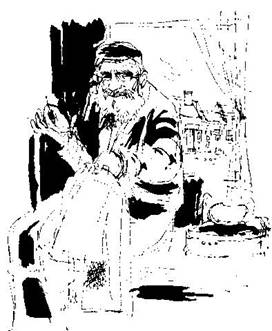
REB MOSHE BEN ISRAEL WASSERZUG
By E. E.
Page 25
The above - according to his memoirs - served at the end of the 18th century as a "go-between" of the Jewish community in Plotzk in its relations with the authorities, and as ritual slaughterer ("Shohet"). But as a result of frictions between him and his superiors in the Kehila, he was forced to resign.
Thereafter he did not leave town, but being a man of initiative, bought a plot of land outside Plotzk, where he built an inn in 1803, the first in the town. This large-sized inn served travelers, merchants and people on official duty who came to Plotzk.
Its owner and manager, Moshe Wasserzug, distinguished himself by his great ability. When the inn was partly destroyed by fire in 1807, he rebuilt it. "In a short time I succeeded", he writes, "to build it all again, including stables for 70 horses and sheds for the carts..."
Those were the days of the great French campaign against Russia, civilian traffic stopped altogether and Moshe Wasserzug lost his livelihood. Thanks to his connections with the authorities he was granted a license to collect slaughtering fees in Plotzk and Wyszogrod, although this was not considered an honest occupation, since such license-holders were in the habit of paying the authorities a certain sum, whilst keeping the remainder. He, eventually, became rich and sued the Plotzk Jewish communal authorities for their accusations against him during the years of his service in the community.
Heinrich Loewe, the publisher of these memoirs, states that they contain authentic facts throwing light on the daily life of Polish Jews at the end of the 18th century.
AVRAHAM YAACOV PAPIERNA (1840-1919) TEACHER AND LITERARY CRITIC
By
Shlomo Greenspan
page 26
The above lived in Plotzk for 45 years. He came there when he was appointed as a teacher of Jewish religion in the Russian governmental secondary school. Being a Russophile, he advocated adherence of the Jews to Russian culture and dissociation from Polish cultural influences, and soon became Inspector on behalf of the Russian educational authorities for all the Jewish religious schools (known by the name of "Heder") and advised the authorities on the possibilities of modernizing these institutions.
He made a name for himself as a literary critic and his essays on Hebrew literature exerted considerable influence on his contemporaries. In his essays he fought for the raising of cultural standards and against the ornate and unnatural pseudo-Biblical style employed by most of the "Haskala" Hebrew writers. He also wrote books on modern methods for teaching Hebrew and Russian.
Thanks to his activities he enjoyed great popularity in Plotzk and although the extreme religious circles regarded him with suspicion, his personality was respected by the general Jewish public and his home served as an important cultural center.
The Jewish population of Plotzk celebrated his 70th birthday in 1910.
Avraham Yaacov Papierna is considered the most illustrious of the three great Jewish literary critics of his time in Poland, who guided Hebrew literature onto new ways.
AHARON BEN MOSHE KAHANSTAM (KONSTAM)
By
Eliyahu Eisenberg
page 27
This article is a tribute to the memory of Aharon ben Moshe Kahanstam (1860-1920), a Plotzk-born outstanding Hebrew pedagogue who devoted his life to the spreading of Hebrew education in several places in Poland and Russia. He was a pioneer of modern Hebrew and established courses for Hebrew teachers who later contributed a great deal to Zionism and Hebrew education.
As a young man he began to practice Law but soon decided to devote his life to education. Upon leaving his job as an assistant in an advocate's firm in Plotzk, he studied to become a teacher. When offered the directorship of a Lodz Jewish religious school, he accepted this challenge enthusiastically and wrote in his diary: "a new epoch begins in my life".
Kahanstam was soon regarded as a central figure of Hebrew education. He showed a lively interest in his pupils' social background and was very active in social work.
From Lodz he moved to Petersburg, where he spent nine years in the Jewish educational sphere. During all those years he was constantly in conflict with sponsors, administrators and other officials who had no understanding of sound educational principles. In 1907 he moved to Grodno where he founded and directed the "Pedagogical Courses of Grodno", whose influence on Hebrew education was outstanding.
Students and teachers who were privileged to study under Aharon ben Moshe Kahanstam admired his fine personality and a number of them published in Tel-Aviv in 1936 a book called: "Rishonim" (The First), dedicated to their unforgettable teacher and leader. These memories contain details about his devotion to the cause of Hebrew education, his influence on all those who came into contact with him, his struggles and zeal for progressive teaching methods, and the appreciation of the assistance he gave Jewish girls who aspired to the teaching profession from which they were barred in those years.
His last stage was the Ukrainian city of Kharkov, where he became the guardian of Hebrew education till the last minute of his life. He succeeded in ignoring the existence of the Bolsheviks who tried and finally succeeded to liquidate all national and Hebrew schools in Russia.
When he died in 1920, one of the mourners, although an opponent, stated: "With the death of Aharon ben Moshe Kahanstam the conscience of the Hebrew teacher has passed away".
"Although the venues of his influential and blessed activities were outside Plotzk", says the author of this article, "we can't publish the Plotzk Memorial Book without paying tribute to a great son of our town".
by
Shlomo Greenspan
Pages 28-32
RABBI YEHUDA LEIB
MARGOLIES - A PIONEER OF SCIENCE AND FIGHTER FOR JUSTICE
It is to the credit of the community of Plotzk, that its rabbinical seat was occupied during the eighties of the 18th century by an outstanding personality, who did much to tear down the spiritual walls of the ghetto, with which the Jews of that period were still surrounded. This man was Rabbi Yehuda Leib Margolies, also known as Rabbi Yehuda Perle (1747-1811 or 1818).
New winds of freedom and equality, finally culminating in the French Revolution, began to blow even in the hermetically closed world of Polish and Russian Jewry, which frowned on any secular education whatsoever. The Talmud was the sole source of knowledge, when Rabbi Y. L. Margolies took upon himself to spread the knowledge of Nature amongst the Jews, for which he was not even attacked by the most orthodox, due to the great authority which he enjoyed. Margolies was labeled by Aharon Zeitlin as an "anti-Mendelsonian enlightener", i.e. a "Maskil" who remained within the religious camp. Dr. J. Zinberg describes him in his "Literary History of the Jews" as a fighter for the ideals of enlightenment and against the forces of darkness. Dr. Joseph Klausner, as well as Ben Zion Katz in his "History of the Enlightenment of the Jews in Russia" quotes him as advocating the coexistence of secular knowledge and science with piety and the fear of God.
Rabbi Y. L. Margolies was the author of nine books, mostly dealing with Natural Sciences, Philosophy, Grammar and others. His foremost work, "Or Olam", first appeared in 1777 and saw several editions. In this book he showed himself to be a follower of the Aristotelian school of philosophy, which in his opinion is not in conflict with the Law of Moses. In his book "Tal Orot" (Pressburg, 1843), he comes out in favor of a more tolerant and liberal attitude towards the Christian nations, amongst which the Jews dwelled, and preaches higher moral and ethical standards in the relationship between the well-to-do and the poorer segments of the Jewish communities. His fearless stand in the forefront of humanitarian and social reform made him widely known, far beyond the confines of Plotzk, so that he was well remembered as a spiritual leader in Poland for many decades after his death in Frankfurt on the Oder in 1811 (or 1818).
RABBI ZYSZA
PLOTZKER
A Monograph of an outstanding rabbi, who lived in Plotzk in the 19th century. Since 1830 the above served as rabbi of Plotzk where he was very active in establishing peaceful relations between various groups who fought for influence in the community. His house became a Torah-center, frequented by many Chassidim eager to hear his discourses on the Sacred Books.
He collected pious sayings of the Hassidic Rabbi of Przysucha, whom he revered, in a book which was published after his death. Several other books of his were published by his grandson several years before the outbreak of the Second World War.
In 1940, when the Nazis were about to convert the old Jewish cemetery of Plotzk into a garden and use the tombstones for street paving, some of his adherers went to the cemetery (103 years after his death) and transferred his remains to another place. The author adds that in spite of the long time which had elapsed since the burial of Zysza Plotzker, his bones had remained intact...
RABBI SHMUEL BEN
AZRIEL
In the second half of the 18th century there served a rabbi in the community of Plotzk, whose spiritual home was the school of German rabbis. His father, Rabbi Azriel, had been rabbi of Landsberg and he himself had studied in his youth at the Yeshivoth of Amsterdam. Having lived some years in Poznan he was appointed rabbi of Kutno and later on of Plotzk, where he died in 1772.
Rabbi Shmuel published two books : "The pillars of the World" (Amude Olam), Berlin 1741, and "Samuel's Belt" (Hagurath Shmuel), Frankfurt on the Oder.
His book "Amude Olam" contains several interesting biographical notes, amongst which we find the description of a ritual-murder accusation leveled against the Jews of Poznan as a result of which two-third of the Jewish community, together with Rabbi Shmuel, had to flee from this city.
After lengthy negotiations the matter was finally brought to an end when the Chancellor of Poland forced six witnesses from the Polish aristocracy to testify to the innocence of the accused Jews of Poznan.
RABBI ARYE LEIB
ZUNZ (REB LEIBEL CHARIF)
The Rabbinical chair of Plotzk was occupied during the first quarter of the 19th century by a great and well-known sage, Rabbi Arye Leib Zunz, who was appointed at the age of thirty to the seat of Rabbi Y.L. Margolies. He had already been famous in the Rabbinical world since his eighteenth year of life, when he compiled a book by the name of "Yaelat Hen".
Having served in Plotzk for a period of ten years, he remained ever after faithful to the town by giving the title "Rabbi of Plotzk" in all the 25 books written by him. He was known among the Jews as the "Plotzker Rav".
After leaving Plotzk he served the community of Praga, near Warsaw, after which time he retired in order to devote his latter years solely to the writing of books. Most of them were actually published only after he passed away in 1833, a number of them reaching several editions. Some of the greatest Polish Rabbis were pupils of Rabbi Zunz; most famous amongst them - the founder of the Chassidic Dynasty of "Ger", Rabbi Itche Meir Alter, the "Baal Hidushey Harim".
Many stories about Reb Leibele Charif made the round amongst the common people and it was widely believed that all his blessings and wishes would come true. One of these tales concerns Rabbi Avramele of Ciechanow.
RABBI ABRAHAM OF
CIECHANOW, THE PLOTZKER "ILUI"
Rabbi Abraham the Zaddik of Ciechanow, one of the famous Chassidic saintly men who influenced the Jewish community of Plotzk during the first half of the 18th century, was descended from simple folk. His father, Reb Rafael Dobrzinski had sent him as a youth to study Torah in Plotzk where he very soon made a name for himself by his steady learning and thorough knowledge of the Holy Books. One of the richest men of the community, Reb Dan Landau, gave him his daughter for a wife. He remained in the house of his father-in-law, even adopted his family name until he was called to serve as Rabbi of Ciechanow, where he came under the influence of the Chassidic sect. Although he was not at all eager to act as a Rebbe, the Chassidim of his town and the surrounding area elected him as their Zaddik. Numerous tales are told of his wisdom and erudition. (See Yitzhak Rafael - "History of Chassidism", Tel-Aviv 1946).
After his death in 1875 several of his books such as "Abraham's Virtues" were printed. The popular image of the Rabbi motivated his great-grandson Zysche Landau, a poet who was born in Plotzk, to dedicate one of his poems to the memory of that great man, 40 years after he had passed away.
RABBI YISSACHAR
DOV GRAUBART - N. SOKOLOV'S RABBI
Rabbi Y. D. Graubart was born in 1842, at Shrensk, where he studied at the local Yeshivah and from where he was called to serve as Rabbi of Plotzk. He married the daughter of a local Dayan, Rabbi Ascher. Among his pupils we know Rabbi Yona Zlotnik of Plotzk and Rabbi Yehuda Leib Zlotnik, who became a well known Rabbi in Canada and carried out a great deal of research in the sphere of Jewish Folklore. Best known among his pupils was Nachum Sokolov, later the President of the World Zionist Organization.
Exceptional wisdom and knowledge, simplicity and humility were the outstanding characteristics of Rabbi Graubart. Great love for and understanding of the average simple Jew motivated him in all his Halakhic decisions. He gave the Hovevei Zion unofficial support. One year before his death in 1912 he also participated in the Founding Conference of the Agudath Israel movement which took place in Kattovitz. Rabbi Graubart passed away in 1913 at Bendin, where his son Rabbi Yekutiel succeeded him until his immigration to the U.S., where he served as rabbi in Brooklyn, Chicago and Canada. A daughter of Rabbi Graubart, Rosa Jacobovitz, was well known in Poland after the first World War as a Yiddish poetess. One of her poems is dedicated to "My Father".
RABBI ELEAZAR
COHEN
When Rabbi Eleazar Cohen was appointed to the Rabbinate of Plotzk, he was already at the age of 65, but his bonds with the town go back to his early youth. Born in 1791 in Warsaw, he was sent by his wealthy father at the age of 9 to study at the Plotzk Yeshiva. In Warsaw he continued his studies under Rabbi Arie Leib Zunz, who had also served, at a different period, as Rabbi of Plotzk. Many years passed, when Rabbi Eleazar, serving at that time the community of Makov, received a call to become Rav of Plotzk. However, he was very hesitant to accept this call, since he was well aware of the fact that various factions, not all of them strictly orthodox, existed within the community. He consulted, one after the other, Rabbi Abraham of Ciechanow, the Zaddik of Kotzk and Rabbi Itche Meir, the Zaddik of Ger. Their consensus of opinion was that he should not be deterred by any hindrances and proceed immediately for Plotzk. Finally, he consented to serve there on condition that a unanimous letter of appointment be sent to him over the signatures of all Plotzk community leaders. The full text of the letter of appointment is quoted in the Hebrew section.
The community received him with great joy, but became divided in their loyalty to him, as soon as he had preached his first Sabbath sermon in which he demanded the strictest possible observance of the day of rest. The more enlightened opposed him vehemently, whilst the faithful were very happy to have him as spiritual guide. During his 6 years of tenure of office in Plotzk (1856-1862), Rabbi Eleazar was constantly embroiled in various frictions with the Gabayim of the community; so that he had no interest in renewing his contract and went on to serve in Pultusk and Sochaczew. His life-work "Hidushey H'Redak" was published after his death (1913) by his son Yehoshua.
One of Rabbi Elazar's young pupils was a student from Wyshogrod, Nahum Sokolov, who describes in his memories the movement of the "Enlightenment", which had penetrated the community and changed its old-worldly atmosphere, a fact which made Rabbi Elazar's position there so complicated.
RABBI AZRIEL ARYE
LEIB RAKOWSKY - THE FIGHTING "MITNAGED"
The rift which developed within the Jewries of Poland and Lithuania in the 19th century, when the ideas of progress and enlightenment, originating in Prussia and Eastern Germany, collided with the Hassidic way of life, did not bypass Plotzk. The sect of the Chassidim became so strongly rooted there during the second half of that century, that their opponents, who were in charge of community affairs, decided to invite as their Rabbi a personality, who was known as an uncompromising opponent of Chassidim. Their choice fell on Rabbi A. A. L. Rakowsky.
When he arrived in town the Chassidim immediately fought him vigorously, so that he was forced to leave Plotzk for Lomza. An epidemic, which broke out soon thereafter was regarded as a punishment of Heaven and a delegation of notables was sent to Lomza to persuade the Rabbi to return to his flock. From then on his position in the community was considerably strengthened, although the Chassidim never adopted a friendly attitude towards him. He persisted in introducing modern teaching methods and other progressive innovations in the local Talmud-Torah. The Chassidim retaliated by denouncing him to the Russian authorities, which almost led to his arrest.
The establishment of a Jewish hospital in town and various improvements in the situation of the poor are to his credit. He served the community for 17 years until he could not bear the communal friction anymore and accepted in 1880 a call for Mariampol, where he passed away in 1893.
JEWISH LIFE IN PLOTZK IN THE LIGHT OF HEBREW
PERIODICALS OF THE SECOND HALF OF THE 19th CENTURY
By Shlomo Greenspan
Pages 33-35
"HAMELITZ" ON
THE BEGINNINGS OF ZIONISM IN PLOTZK
At the beginning of this article the author stresses the fact that the Zionist idea had adherents in Plotzk, long before the Zionist organization was founded. Yitzhak Lederberg (great-grandfather of the Nobel-prize winner Dr. Yehoshua Lederberg) went to Eretz Israel in 1830 and a few decades later the Zionist activities of Plotzk-born people were already widely-known.
In 1891, with the foundation of a branch of the "Hovevei Zion" movement in Plotzk, formal Zionist activities began.
The author quotes excerpts from the then famous Hebrew periodical "Hamelitz", reporting on Zionist conventions and daily Zionist activities, including money-raising campaigns which took place in Plotzk.
ITZHAK GRINBAUM AND
AHARON BECKER - PILLARS OF ZIONISM IN PLOTZK
In his essay "The Jews in Plotzk", I. Grinbaum, formerly a leader of Polish Jewry and first Minister of the Interior of Israel, describes how a Zionist youth-group was founded in Plotzk at the end of the 19th century. That group was named "Mazkeret Shmuel", in honor of Rabbi Shmuel Mohilever, a famous leader of the religious wing of the Zionist movement.
I. Grinbaum, and A. Becker (from Lithuania) who had settled in Plotzk, were the founders and initiators of that group. The latter became soon leader of the younger generation, on which he exerted great influence.
The above-mentioned "Hamelitz" dedicates a special review to that event and mentions the obligation undertaken by members of the group to pay between 10 and 25 "kopeikas" (Russian coin) every month.
The same periodical published an article at the beginning of this century from which we learn that the local Zionists earnestly endeavored to assume responsibility for the affairs of the Jewish community (Kehila) in accordance with the Zionist aim and slogan of "Kibbush Hakehilot" (Conquest of the Communities).
THE PRE-ZIONIST EPOCH OF
NAHUM SOKOLOV
The great Zionist leader and famous Hebrew journalist and writer Nahum Sokolov was brought up in Plotzk. Before he joined Zionist groups formally, and took part in manifold Zionist campaigns, there had been times when he dissociated himself from Zionism. This information is contained in an article published in another Hebrew periodical of those times, called "Hamaggid".
EDUCATION AND CULTURAL
LIFE
Articles written by Nahum Sokolov are a faithful source for the reader who wishes to acquaint himself with the general trend and ideas of the younger Jewish generation of Plotzk, which at the end of the 19th century strove for the introduction of "general" studies side by side with Jewish studies. In his articles Nahum Sokolov describes the miserable conditions under which Jewish youth lived - without proper clothes, half-hungry, arguing with their parents about the necessity of general studies in order to change the depressing living conditions then prevailing in the Jewish communities.
Under the influence of the "Haskala" (Enlightenment) ideas, some families began to send their children to general secondary schools but had to fight for their right to do so with conservative groups who considered general education as the first step towards the repudiation of Judaism. The problem of writing on Sabbath-days hindered many parents, faithful to the Jewish religion, from sending their children to "general" schools.
We also find in these periodicals letters about the financial difficulties encountered by the Jewish community in maintaining its schools and paying the teachers' salaries. In order to overcome those difficulties - we learn from the "Hamelitz" - the communal leaders even agreed... to organize a theatre-show in order to collect some funds.
But in spite of the "Haskala" movement the rabbis were very popular with the general public and leaders of the community showed them great respect.
In the "Hamelitz" of 1890 we read an interesting story about a rabbi who successfully passed an examination in Russian. The periodical adds that the examiners admired his "thorough knowledge of the Russian language".
PUBLIC INSTITUTIONS AND
SOCIAL WORK
An 1891 issue of the above periodical describes the growing poverty of the Jewish population and the necessity for overseas emigration. The retail merchants were forced to pay high interest for goods purchased on credit from wholesalers. A proposal was made to establish a wholesale store for the benefit of the retail merchants but for some unknown reasons this plan never materialized.
There existed in Plotzk a society whose members volunteered to visit sick people at the hospital as well as to distribute among them tea and sugar. The society "Bikur Holim" did a fine job in preventing a typhus epidemic in 1867.
Artisans were organized in various professional unions who aimed at rendering social aid to members.
In another issue of "Hamelitz" we read about a legacy of a rich woman (5000 Russian rubles) for building an asylum for old people, unable to earn their living. The establishment of that institution was very important as from other sources we learn that in those days many Jews in Plotzk reached a very high age.
RELATIONS WITH POLISH NEIGHBOURS
Although there is no special evidence on anti-Jewish riots, we read about an incident which occurred during a Jewish funeral. Two Polish landowners barred the way of the mourners and did not let them enter the Jewish cemetery. As a result 30 Jews were injured. Fortunately, the district governor, who was friendly towards the Jews, helped them in restoring their rights to the cemetery.
A certain Niemski used in his book, while describing the beauty of the town, offending expressions with regard to the Jews of Plotzk and their way of life, calling them "a caravan of Gipsy-Jews" etc.
EMIGRATION
From many Polish towns a mass-emigration started at the end of the 19th century. Plotzk's part in that emigration (especially to the U. S. A.) was not considerable, because its Jewish inhabitants did not suffer in those days as much from anti-Semitic riots as Jewish communities in the Ukraine and Bessarabia.
Not far from Plotzk two important industrial centers, Warsaw and Lodz, attracted many jobless Jewish young people who tried to find employment as factory workers in those towns. This was not too easy because even Jewish industrialists were not always willing to employ them out of fear of negative reactions from Christian workers.
The Jewish emigrants had to sell all their belongings in order to be able to buy boat-tickets to the U. S. A. or to cover at least their travel-expenses to Berlin. Their sufferings on the way to America, not having any hope to earn their living where they were born - are described in the periodicals of that time.
*
A perusal of the Hebrew press at the outset of the 20th century convinces us that the members of the Jewish community of Plotzk were among the first who adjusted themselves to the new era of Jewish national renaissance.
By Florian Sokolov
Page 36
The author, who is the son of the famous late Zionist leader Nahum Sokolov, describes his prominent father's youth in Plotzk.
It appears that young Sokolov was greatly influenced in his time by the Jewish atmosphere of the community, its youth, Jewish national movements, rabbis and centers of religious and secular education. Nahum Sokolov, throughout his life, even while a resident of great European capitals, remembered his childhood in Plotzk. In one of his letters to his daughter he reveals in nostalgic expressions his great affection for "his beloved Plotzk".
BEGINNINGS OF ZIONISM IN PLOTZK
By Itzhak Grinbaum
Page 36
The author, who was a leader of Polish Jewry before World War II and the first Minister of the Interior of the State of Israel, describes the period between the first and second Zionist Congresses, when the first Zionist group was organized in Plotzk. The author describes in this connection the various cultural activities as well as the disputes prevailing between Zionists and their opponents in the community. He mentions the names of local Zionist leaders and of personalities of the different groups ("Bund", Polish Socialist Party and others) with whom he maintained contacts during his political career. He portrays, among others, the life of Esther Golde, a woman fighting for socialism, who played an important role in the general Polish Socialist Movement and did not display any interest in Jewish problems. Grinbaum visited Plotzk after the war but found no Jews there.
The classical assumption that the disappearance of the Jews from the economic, cultural and social life of the town would create a vacuum did not come true.
*
Itzhak Grinbaum was the Guest Speaker at a Memorial meeting of the Plotzk Association, which was held in 1951 in Tel Aviv. On this occasion he delivered a thoughtful speech, containing many reminiscences of the town in which he spend nine years of study at the local gymnasium.
Mentioning the various cultural and educational institutions, he drew loving portraits of the teachers Shmuel Penson and A. Y. Papierna, the revolutionary leader Josef Kwiatek and others, who left their imprint on the minds of the young generation, and thanks to whom the Jewish Youth in Plotzk became spiritually elevated and intellectually more broad-minded.
INAUGURATION
OF THE JEWISH GYMNASIUM
By Y. M. Zlotnik
Page 37
Excerpts from a booklet, published in 1917, which includes the speech delivered by the then rabbi of Plotzk, R' Yona Mordechai Zlotnik at the inauguration of the first Jewish secondary school in Plotzk.
The attitude shown by the above to general and secular Jewish education was at that time quite different from that of other rabbis. He understood the modern spirit of the Jewish youth well and knew that their assimilatory trends would not be checked by "Chadarim" and "Yeshivot" alone. For that reason Rabbi Zlotnik saw in the establishment of Jewish secondary schools a stronghold of Judaism. He demanded from his teachers' devotion to their extraordinary responsibilities. "We are now on the eve" said the rabbi, "of the establishment of Jewish secondary schools and you, the teachers, have to be pioneers in this field, and in the future you will be recognized for your work".
His speech contains a few sentiments directed to the Christian population. He explains that for the good of both Jews and Christians primary education should be separate because just as it is impossible to give Christian children a good Christian education in Jewish schools - Jewish religious education is possible only in schools established exclusively for Jewish children.
The late Rabbi Zlotnik expressed his hope that one day a Jewish central institute for higher education - a university - would be established. The rabbi expressed already then, in 1917, his longings for a Hebrew University to rise in Jerusalem.
He concluded his words to his pupils by expressing his hope that they would adapt themselves through the influence of the new school to the aim of returning to their homeland Eretz Israel.
By Shlomo Rozen
Pages 37-38
The author pays tribute to some personalities who lived in Plotzk at the beginning of the century, especially of the Chassidic circles. He describes their orthodox way of life, adherence to different Chassidic rabbis and their influence on that part of the younger generation which devoted itself to the study of Torah and its commentaries. He also mentions a famous cantor whose prayers, together with a choir, afforded the listeners great spiritual enjoyment.
The second chapter describes the various groups of Jewish orthodox youth who gathered in the local Beit Hamidrash. Some of those young people later became famous in Jewish life in Poland and elsewhere, among them Rabbi Zlotnik-Avida and others.
The third chapter is dedicated to the new ideas of progress, within both secular and religious Zionism, which shaped the ideologies of those young people. The author mentions the activities of Itzhak Grinbaum, Rabbi Lifshitz and others.
The second part of this article deals with the assimilationist groups of the Plotzk Jewish community (the Kempner family and others) and with the people who lived in the vicinity of the "Iron Gate" - a market place where simple folk (tailors, butchers, fishmongers) lived and worked. The author nostalgically describes these types of Jews, who added a special flavor to the multifaced Jewish population of Plotzk.
Last updated May 17th, 2004

