שמעו זאת הזקנים
והאזינו כל יושבי הארץ
ההיתה זאת בימיכם
ואם בימי אבותיכם:
עליה לבניכם ספרו
ובניכם לבניהם
ובניהם לדור אחר,
יואל – פרק א' 1-4
Hear this, ye old
men, and give ear, all ye inhabitants of the land. Hath this been in your days,
or even in the days of your fathers?
Tell ye your
children of it, and let your children tell their children, and their children
another generation. Joel Chapter I (1-3)
Testimony
of Saraleh Batscha (Mondula), Cluj - Napoca Transylvania
Testimony of Saraleh Batscha ne'e Mondula z"l, a
member in Kibbutz Evron. She was
from Cluj, Napoca,
A joint initiative of Judy Cohen and
Judy Cohen's
"Women and the Holocaust"
Saraleh Batscha
interview in "Generation to
Generation"
The daughter Nitza asks questions, and her mother Saraleh answers.
Nitza: Mother, I know that in the days of
the Second World War you were taken to Auschwitz. However, I know so little
about what happened before and in
Saraleh: I was born in 1917. My
father was a teacher, and my mother was a housewife. We lived in Cluj, the
capital city of
Nitza: You must have told everyone at home what you saw. What did you do? Did you and the family run away?
Saraleh: We did not do anything, and we
did not run away. We thought that it would be just that one incident. The Jews
in Cluj, at that time, did not even think about the possibility that it could
also happen to them. But reality was different. That night at
The next day in the afternoon the men of the "Sonderkommando" came, and ordered us to clear out of the apartment. Father went to the city and brought a horse and carriage. We loaded up our things and the whole family moved to my cousin Edit's apartment, who lived on another street. We had to wear yellow patch. We lived at Edit's place for a few weeks. One morning, at about 5:00, o'clock, they ordered us out of the house and moved us to a brick factory. We were only allowed to take one small package of items for personal use.
Nitza: How many Jews were brought to the factory?
Saraleh: All the Jews of Cluj, about 10,000. Hungarian soldiers helped the Germans guard us. When we arrived, they immediately took everyone's watches and jewelry. We lied on the ground, forming lines in every corner.
Nitza: How long were you there? What did you do? Did you try to organize yourselves? Was there panic, hysteria?
Saraleh: It happened at the end of May 1944. We were in that factory for a full month. We did not do anything. We were just lying on the floor. People were quiet.
Nitza: When did they take you out of there?
Saraleh: In the beginning of June, during Shavuot holiday. They took us to the train station and crammed us into freight cars that were built to ship cargo. We were together, our whole family. They told us that we were going to some village, and we would work there. We understood what the Germans told us because we spoke Yiddish.
Nitza: I heard from someone or I read that Hungarian Jews were deported to the concentration camps in passenger trains, in normal conditions, so that they would be deceived and would not cause problems.
Saraleh: That is not true. It is possible
that some Jews originally from
Nitza: What happened when the train got to
Saraleh: They let us out of the cars. On the platform stood a German officer, who, I found out later, was Dr. Josef Mengele. He divided anyone who arrived into two groups, one on the left and one on the right. My mother, my father, and Edit's mother were moved to the left. Edit, my cousin, Edit's sister, and I were moved to the right. Also, my brother Lolo went to the right. Then, we did not know that left meant death, and right meant delaying time.
Nitza: What happened to the baby that you prepared porridge for in the car?
Saraleh: The mother was a young woman,
about 30 years old. She held the baby in her arms. The Jews from
The next day, the mother burst out in shrieks: "Where is my baby?! Where is my baby?!"
Now that I too have children, I can understand
her pain. In our transport, there were many babies. After the sorting, they
took us to
They engaged us by making us move stones from place to place, useless work. In our block there were no bunks to sleep on. We had to lie on the bare floors. In Edit's and Yehudit's block, there were bunks. After one of the selections, when people were taken away, some spots became vacant there. Edit sent Yehudit to me and transferred me to their block. There was a spot for me at the bunk. By then, the Germans' order and discipline did not function as before, so this risky transfer could be done. Prisoners of the block I was in before I was transferred, were all killed. I was saved from death by slave labour.
They held us in roll-calls for many long hours.
My gown was infested with lice. One day, when the hunger was eating at me and I
thought my end was near, I gave my gown to my neighbour and in return he gave
me a slice of bread. In October 1944, they took us to a factory that belonged
to an electrical firm, "Telefunken", to work there. There, they
manufactured tools for the army. The factory was near the Czech border. My
knowledge of the German language helped me a lot. I worked in the office,
writing serial numbers for the products. For a while, Edit and I worked in
different sections. For reasons I cannot explain, they did not take us on the
"Death March" to
Nitza: How were you liberated?
Saraleh: One morning in May 1945, we heard
shouts. The young men who worked with us in the factory already knew that the
Germans were retreating and the Russians were advancing. They cried: "We
have been freed! We have been freed!" The German guards fled. The next day
we ran away, and ended up past the border in a Czech village called Pisarova.
The Czech villagers welcomed us nicely. We were in the village for a few weeks,
and then I returned by train to
Nitza: Mother, is this too difficult for you? Do you want us to stop for a while? I will make you a cup of coffee and then we shall continue.
Saraleh: On the way to
At the train station in
But I decided to go to Cluj also, to see if someone from my family survived. In one of the suburbs of the city, I entered the house of the farmer who used to deliver milk to our house. My mother trusted him and placed in his hands belongings and valuable things to keep. Among these items was bedding, she prepared for my dowry. The farmer expressed sadness. He said he no longer had the package my mother gave him. "The Russians stole everything, and I was even lucky to be alive". He was a liar, and an anti-Semite.
After, I went home. The house was still standing. The furniture, the clothes, the dishes, and the kitchen - everything was robbed. An empty house. No one lived in our house. I did not find anyone from my family, acquaintances or friends.
I returned to the training center in
Nitza: Mother, how did you meet your brother Lolo?
Saraleh: Lolo was in Auschwitz. A large
group of Jews was taken from Auschwitz to Warsaw. Lolo was in that group. They
brought the Jews to clean the remnants of the destroyed
At the end of the war Lolo went to
In
Last words by Nitza to the testimony of Sarah Batscha
The story has ended, but the issue has not... I, her daughter, feel like a demon has forced me to concentrate on my mother's testimony. She spoke with such flow that it was like the demon in her body grabbed her, and when she let everything out, she could never tell the whole story again.
I think to myself, we should have heard this story a long time ago. Maybe if Mother would have told us years ago she would have released the burden on her heart. Maybe we would have made it easier for her if she knew that we are part of her life story, to her fate and to her family's fate. Maybe our family and friends of the Kibbutz would have found more patience, more feeling, and more willing to give her the help and the support she needed.
40 years needed to pass so that our parents, the survivors, would open their closed hearts to tell us about their overpowering and strangling distress.
40 years needed to pass so that we, the second generation, would open our closed hearts in order to hear each other, and maybe, if even possible, to try and deal together with this atrocious horror that could not be grasped, and with this horrible pain that we left our mother's womb with. The pain that we breastfed on, and the pain that we will carry for years until the end of life...
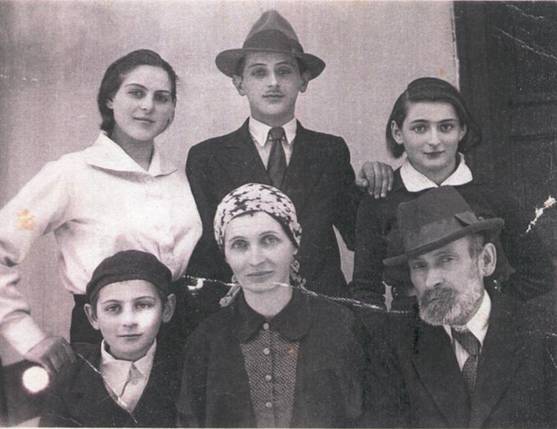
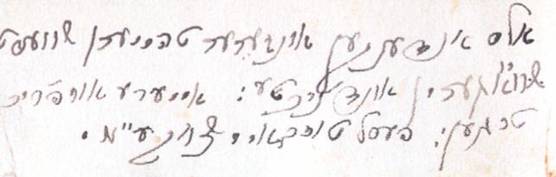
Sitting to the right: father Itzhak Mondula, mother Pesel Tojwe (Josephine)
murdered in the
gas chamber of
Standing to the left:
Karmela Tivon ne'e Mondula z"l, Mordechai Mondula z"l and Sareleh
Batscha ne'e Mondula z"l survived

Back
to Holocaust Testimonies Web Page
Posted on Yom Hashoah,