Leo Melamed:
Sugihara's Stand
(pages 27 -
37)
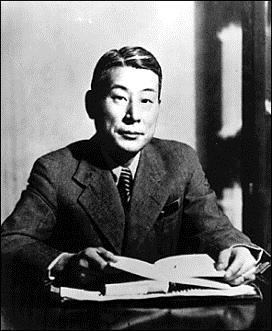
Chiune (Sempo) Sugihara,
Righteous among the Nations (Khassid Umot Olam)
My father had rented a one-room loft for us
on the second floor of an old building on Straszuna Street in the heart of
Wilno's historic Jewish quarter. The neighborhood was a warren of narrow
streets pulsating with commercial vitality. Our street was within the city's
butcher section. Its frenzied pace was a collage of scurrying shoppers,
horse-pulled wagons clippity-clopping, and rickety trucks belching black smoke
from their exhausts loaded with freshly cut carcasses of beef and veal for the
city's butcher shops. In their windows hung slabs of meat, ladders of sausages,
limp-necked geese and chickens. All week long a stream of blood from the meat
ran down the gutters in a constant flow until Friday afternoon when the bustle
slowed down in preparation for the Sabbath.
I had never seen a sight like Straszuna
Street before or since. It captivated me. Our flat's only feature was a tiny
terrace overlooking the street. It had an iron railing and just enough room for
one person to step onto. I would often stand there staring at the scene below
with its busy shoppers carrying their koshiks, shopping bags, its many
butcher shops, its hairy-armed butchers in blood-splattered aprons wielding
their cleavers with scalpel precision while they yammered in Yiddish with
customers. There were no slicing machines. Instead, the sharp eye and steady
hand of the butcher would saw off cuts of meat in perfect slices, each with the
same thickness.
Over the centuries, Lithuania - the last
stronghold in Europe against Christianity - had been pulled and tugged at by
the Poles, Russians, and Germans until it became a remnant of its glory days
when its domain stretched from the Baltic to the Black Sea. It regained
independence again by taking advantage of the Russian Revolution in 1918 and
proclaiming itself independent until June 1940, when the Russian troops took
over. A year later, Lithuania would fall into German hands until 1944. Then the
Russians were back in control again.
Wilno's Jewish population was much larger
than Bialystok's, with nearly 80,000 Jews. In all of Lithuania there were some
155,000 Jews, about 8 percent of the population. Nearly three-quarters were in
the retail trade or industry, some 10 percent were in the professions, and another
10 percent in farming. The Jewish community was active and very visible. For
nearly 150 years, Wilno was the center of Eastern European Jewish cultural life
that traced its origin as far back as 1568. The city became renowned for
rabbinical studies and religious lore that produced texts of the Mishna,
the commentary on the Talmud, still in use today. In the nineteenth century,
Wilno became the center of Jewish enlightenment and later a flourishing source
of Hebrew and Yiddish literature, with Yiddish and Hebrew secular schools, and
a diversified Jewish press. It was in Wilno in 1925 that Dr. Max Weinreich,
and historian Eliyohu Tsherikover, and several other scholars founded
the Yiddish Visnshaftlicher Institute, the Institute for
Yiddish Research, known as the YIVO. The YIVO (since 1940 situated in New
York City) has remained the conclusive authority on the Yiddish language, a
bastion of Eastern European Jewish history and culture, a center housing Jewish
historical and linguistic documentation, Jewish art and ethnographic
treasures, a laboratory for Jewish scholars, and a scholarly publishing house.
At the time we arrived in Wilno in late
September 1939, although there was anti-Semitism, as there was throughout all
of Europe, Wilno Jewish communal life was still thriving. By the middle of
1941, however, that would change. Wilno and Bialystok were destined to fall
into Nazi hands. The entire Jewish population would be herded into ghettos,
their lives eventually to be snuffed out. By the end of the war, 90 percent of
both Poland's and Lithuania's Jews would be murdered. There would be but 6,000
Jewish survivors in Wilno.
For a brief moment, normalcy returned to my
life. My family was reunited. Soon we were visited by friends, the Manns,
who lived nearby. They were Yiddish schoolteachers like my parents; both women
had been together at the Wilno Teachers Seminary. Mr. Mann was a tall
lanky man with a thin face. Mrs. Mann was considerably shorter and much
fatter. The Manns had a daughter my age named Esther. Esther
was about my height, slender, with chin-length, dark blond hair, and striking
blue eyes. Although I had never made friends with a girl before and was
naturally quite shy, Esther made it easy. The smile that lit up her
whole face the instant we were introduced made me feel welcome. I had arrived
with virtually the clothes on my back. Esther shared all her things with
me from the start, and we became inseparable friends.
After about a week, my parents told me that
because my father was safe here, they had decided it was best to remain in
Wilno. They were able to secure part-time teaching jobs in a Yiddish school,
and I was to begin school as soon as possible. This meant I would enter first
grade under Lithuanian rule. The thought was terrifying until I learned that Esther
would be my classmate. She shepherded me to first-grade classes that were
taught in Lithuanian, the oldest surviving Indo-European language that closely
resembled ancient Sanskrit. (To this day I have a little notebook scrawled in
Lithuanian saved from that class). It was to be the third language of my life,
and one of many as fate carried us around the world. Once again, our lives
gained some order. I attended school, and my child's ear began to pick up
Lithuanian to the point where I could communicate in the classroom. Also, my
social life began to expand as a consequence of where we lived. The backs of
all the buildings in our block poured out into one huge courtyard. This became
the neighborhood children's haven where all the kids would gather after school.
Outdoor games were played, fights were held, and friends would gather to talk
or walk or argue. In this courtyard, I learned about sex, about love, and about
life. Here I began to mature. I even attended my first birthday party, held
for one of my classmates, whose name I cannot recall. But I still have a
sepia-colored photograph from that party. Seated around a table are a dozen
children, wide-eyed and laughing, enjoying the moment. Most of them never had
a chance. However, next to me is a young girl, Masha Bernstein, who,
like me, would become one of the fortunate ones to find her way out of the
trap. But not her father, Mordechai, known in political circles as Matvey,
an active Bundist who was arrested at the last moment in 1940 and sent to
Siberia.
Masha and her mother, Zelda Bernstein, followed a similar route to
freedom as did the Melamdoviches, coming to Japan two months after we
did and to the United States via Canada in August 1941 just ahead of the ax man
Masha (now Masha Leon) and I remained good friends over the
years. Our paths would often cross in adulthood as she became a reporter for
the Forward in New York. To this day, she authors a highly successful
and popular weekly column, tracking the worthy events and personalities of the
Jewish scene. She never fails to mention my exploits.
Life had settled into a routine during the
next six months, and just as I began to believe that things were normal again,
fate intervened. The war was closing in on Wilno, and the city's life lines of
goods were being squeezed along with the psyches of its inhabitants. Rumors of
what the Germans were doing to the Jews and other nationals, in the west had
reached Wilno striking panic in the hearts of Lithuanian Jews given the limited
options of escape routes: to the north was the Baltic Sea already dominated by
German submarines and patrol planes, and to the east stretched the vast Soviet
Union.
Wilno's transformation began when Stalin had
a change of mind in July 1940. He wanted Wilno back from the Lithuanians, and
while he was at it, he took back all of Lithuania, along with Estonia and
Latvia. The three Baltic states were now in the hands of the Soviets, and they
wasted little time rounding up thousands of politically suspect Jews and
non-Jews for deportation to slave labor camps in Siberia and elsewhere deep in
Russia. Surely my father and his friends were on one of those lists.
Overnight our world changed. Russia's
reappearance dropped like a heavy drape over the city. Straszuna Street was no
longer manic. Its shops and stores displayed few items. The pickle barrels and
herring vats stood empty, the evaporated brine left a white chalky film on the
inside of the containers. There was no meat. No butchers. The sharp smells that
would spear the nose were replaced by the odor of abandonment and neglect. For
weeks during the summer of 1940, hoarding became a way of life. Long lines for
essentials such as bread and milk snaked around corners. If you didn't rise
early enough and wait long enough, you'd walk away empty-handed.
Again my father went underground. He had
joined the partisans in the forests outside of Kovno (Kaunas), about 80 miles
northwest of Wilno, leaving us in the second-story flat overlooking a forlorn
Straszuna Street. Our small terrace became a signal post. When my mother hung a
towel over the iron railing, my father knew the way was clear and he would
visit. No towel meant danger, stay away - someone was either unexpectedly
paying a visit or an authority was grilling my mother on the whereabouts of my
father. No one, my father said, could be trusted. In any case, the crude
signaling system worked.
I remember the night my father left. He took
me by the hand to explain why he was leaving and that he had to open my
mattress. I surprised him by saying I understood. Once, after we first moved
into our flat, when my parents didn't think I was in the room, I watched as my
father made a deep cut in the mattress on which I slept. There I saw him hide
what looked like some paper money. I never said anything about it. At first
when I slept in my bed, I would be conscious of the money beneath me, but as
time went on I forgot about it. Now my father told me, he needed some of that
money. It was not much, he said, but it was all we had to save us from whatever
fate awaited. So he explained that he had hidden the money there because my bed
would be the least likely place a robber or the police would look. The money
was still there.
Although life around me changed, my personal
existence remained nearly the same. I continued to attend school on a daily
basis, all of the courses remained the same, all of the children were the
same. Esther and I hardly left each other's sides. But there was one big
difference. Everything in school had changed to Russian. Once again I was
learning a new language, my fourth, and I was barely eight years old. There was
a children's Yiddish song we used to sing that went, "one, two, three,
four, small children are we." Suddenly, the words changed to, "one,
two, three, four, Stalin's children are we."
Like everything else in the world that was
unraveling, Lithuania's precarious independence collapsed that summer of 1940.
After last-minute negotiations between its leaders and Moscow, followed by
arrests of dissidents who opposed the deal, on July 14, the Lithuanians voted
to become the fourteenth Soviet republic. The United States refused to
recognize the new regime, even froze Lithuanian assets, and allowed the old
legation in Washington to remain. But that didn't help us. Lithuania's
president fled, and there were some 12,000 Jews and other war refugees also
scrambling to get out. We were among them.
The key was the transit visa. The escape
routes to and from Poland had been cut off. That meant there was no way back to
Bialystok to reach my grandmothers, aunt, and other relatives. It had been
months since my parents had made contact with them. Now the only route open was
through the hinterlands of the Soviet Union to reach the eastern port of
Vladivostok. I couldn't imagine the distance, but after overhearing my parents
discuss the prospect, I knew it was as far as the moon. But my parents told me
Vladivostok was a place where ships sailed away across oceans to Japan, China,
Australia, America. What they didn't tell me was just how slim the chances were
of making it. What we desperately needed was a transit visa, a piece of paper
that allowed a refugee to leave the Soviet Union and enter Japan in transit to
somewhere else. (Ironically, two years later, the Hollywood mythmakers would
use the transit visa, or "letters of transit" they called them, as a
dramatic device in the classic Bogart movie Casablanca.)
In late July, there was more drama tied to
the transit visa being played out on the streets of Kovno than any screenwriter
could conjure up. My father played his role solo but gave his wife and son a
word-for-word, moment-to-moment description of his fears and dangers, his exploits,
and encounters, as he struggled with fate and the hand he was dealt.
Every day for weeks, my father would steal
into Kovno to find himself milling among hundreds of Jews in front of the
Japanese consulate. There was a collective exhaustion outside, and as I learned
years later, inside as well. It was a desperate scene: infants coddled in the
arms of mothers, young boys nervously moving in place, sullen-faced men with
their arms draped over the chest-high fence surrounding the consulate. It was a
crowd of despair, but not a hostile one.
Like everyone else, Isaac Moishe
Melamdovich was hoping to squeeze through some bureaucratic crack for a
dash at freedom. Perhaps he was too frightened - or dazed - to be angry. Even
my philosophic father couldn't explain how a person's life was reduced to
waiting in line for a slip of paper that could mean the difference between
living and dying.
The crowd began to form at 5:00 A.M. Less
than an hour later, the quiet street was choked with jostling bodies as it had
been at the train station in Wilno and in Bialystok the night my father left.
Now the only hope was Japan's consul general in Lithuania, a 40-year-old
soft-spoken man named Chiune (Sempo) Sugihara. When Sugihara peered from behind
the curtained windows of the consulate that morning and saw the crowd below,
he was shaken. So shaken, in fact, he woke his wife and three children and hid
them in a closet. He feared the crowd would storm the consulate, but soon
realized there was no danger. It was the typical crowd in Europe at the time,
made up of individuals who seemed as if they were about to fray. Although I
didn't witness it, by accounts written years later, including Sugihara's own
memoirs, I learned there were those in the crowd who tried to climb over the
fence, and others who put their palms together in a prayerful gesture when they
saw Sugihara as if they had gazed upon a divine vision. They showed no
self-pity or sentimentality because they couldn't afford to break down. But
their drive to escape bordered on ferocity as they lined the streets, waiting
for days outside the Japanese mission.
With so many lives at stake, Sugihara knew
something had to be done, but he was caught in a dilemma: the choice between
conscience and duty. In a world where duty already had taken precedence over
conscience, Sugihara showed extraordinary courage. Beginning July 31, 1940,
and over the next 28 days, he defied his government by issuing transit visas to
Jews. My father, along with the other applicants, pleaded his case before
Sugihara. He never told me what was said. But it made no difference what
rationale was given, my father later explained, because Sugihara wasn't making
judgment calls on individual cases. The pleas were passionate; the analysis
dispassionate. No one had to tell Sugihara the sky was falling. He could see it
in the bloodshot eyes of the applicants, hear it in their hoarse voices, and
read it in the cable traffic from Tokyo.
There was no bickering or arguing. If you
were a Jew, that's all that mattered to Sugihara because he knew full well the
fate of all European Jews. Should he fail in obtaining a visa, my father saw
only one possibility left: to become partisans. My father was prepared to take
his chances as a guerrilla fighter on the run in the Lithuanian wilds with his
family rather than join the Red Army and leave us behind or be herded by the
Nazis and cooped up in some Jewish quarter with death waiting on the doorstep.
I tried to imagine my parents toting rifles - the notion shouldn't have been
that far-fetched given the fact that it was Bund members led by Leon Feiner,
head of the underground Jewish Socialist Bund movement, who organized the
Jewish resistance movement and the fight-until-death uprising in the Warsaw
Ghetto in April 1943. Similar Ghetto uprisings led by Bundists, Zionists, and
members of other Jewish organizations, occurred throughout the cities of
Poland. In Bialystok, the Ghetto uprising, led by Mordecai Tanenbaum, Adek
Bureks, and Daniel Moshkovitch, reached its high point in August
1943.
After the war, I remember the emotional
meeting of my parents and Feigele Peltel-Miedzyrzecki (now Vladka
Meed) at our Chicago apartment at 3210 West Haddon. Under her assumed
Polish name, Vladka, at the age of 17, she had achieved fame as one of
the heroes of the underground movement, smuggling weapons to the Jewish
Fighting Organization in Warsaw, helping Jews escape from the ghetto, and
acting as a courier and resistance organizer. Upon meeting Vladka, my
mother, Faygl Melamdovich, confided to me that Vladka was her
personal heroine. How close we were to that fate. Vladka now lives in New
York with her husband, Benjamin Meed, who became one of the founders of
the United States Holocaust Memorial Museum and is president of the Association
of Holocaust Survivors.
The pressure on Sugihara was inordinate. The
Jewish refugees had learned about the Japanese transit possibility from the
Honorary Dutch Consul, Jan Zwartendijk, who was the only other foreign diplomat
willing to help the Jews. Zwartendijk continued to issue visas to Dutch
territories such as Curacao even after Holland was occupied by Germany in May
1940. But you couldn't get to Curacao except via Japan.
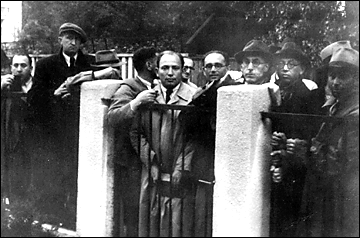
Jews gather at the Japanese Emassy, 1940
Several times, Sugihara cabled his
government for permission to issue visas. Each time the response was in the
negative: "Concerning transit visas requested previously Stop. Advise
absolutely not to be issued to any traveler not balding firm end visa with
guaranteed departure ex Japan Stop. No exceptions Stop. No further inquires
expected Stop. K Tanaka Foreign Ministry Tokyo."
The reason was obvious. The Tripartite Pact
between Japan, Germany, and Italy was in the process of being completed, and
the Japanese Foreign Ministry would not consider anything that would upset the
Germans. Helping Jews was high on that list. The Pact was finally signed on
September 27, 1940.
Sugihara was in anguish. He canvassed his
family at the consulate, which consisted of his wife Yukiko, her younger
sister, Setsuko Kikuchi (who was nanny to the children), and their three sons,
five-year-old, Hiroki, three-year-old, Chiaki, and three-month old, Haruki. The
family was unanimous in urging him to help the Jews. He searched his soul and
made up his mind. He told his wife, "I may have to disobey my government,
but if I don't, I will be disobeying God." His decision to defy his
government orders became known in Japanese Foreign Ministry circles as the
"incident in Lithuania."
But first it was necessary that he get a
travel permit from the Soviets to let the refugees pass through Russia. He had
already received instructions from the Russian government to close his
consulate doors. But unless the refugees were permitted to ride the trains
across Siberia to Vladivostok, they could never get to Japan. Sugihara
personally went to negotiate for the Jews. He impressed the Soviets with his
ability to speak near-perfect Russian. But what clinched a favorable decision
is when the Russians realized they could charge the Jewish refugees more than
double the fare and pocket the difference.
The next morning, at dawn, Sugihara addressed
the Jewish throngs waiting outside: "I'll issue visas to each and every
one of you to the last, so please wait patiently." It was a magical moment
as word passed through the crowd. People began rejoicing as they hugged and
kissed one another while others looked toward the sky in silent thanks. Then in
a hurried and harried state, with the help of his family and staff, and even
some of the refugees who pitched in, Sugihara began issuing visas, literally
scrawling them out day and night. He lost weight, became exhausted. But he kept
writing the visas.
The number of visas issued is uncertain, but
Sugihara tried to issue 300 each day. An entire family could travel on a single
transit visa. Thus, historians have since credited him with saving the lives
of over six thousand Jews in that frantic month of August 1940. The visa
recipients included the entire student body of the Mirer Yeshiva which
today boasts of a branch in both New York and Israel. From Japan the refugees
immigrated to many parts of the world. A few lucky ones got to the United
Sates. By fate, two of those families ended in Chicago - the Melamdoviches
and Rochelle and Berek Zielonka and their daughter Julie,
who was three-years old at the time. The Zielonkas had escaped the
Germans by the skin of their teeth from Sosnowiec, a small Polish town 40 miles
fro n Auschwitz. After receiving the Sugihara visa, they traveled the same
escape route to Vladivostok. It wasn't until they were United States residents
and their son Sam was born that the Zielonkas changed their name
to Zell. Sam Zell is today one of the most renowned real estate
entrepreneurs and probably the single largest private owner of property in the
United States.
Even after he closed the consulate and moved
to a hotel to wait for the train that would take him and his family to Germany,
he continued issuing visas. As the train moved slowly out of the station,
Sugihara managed to hand out yet more visas through the open window to the
refugees. Unfortunately, it still wasn't enough. Hundreds on the platform
without visas watched their last hope pulling away. He would later recall his
words as he bowed to them. "Please forgive me," he said, "I
can't write any more. I will pray for your safety."
Forty years after the war was over Sugihara
would tell a reporter he acted out of humanity. For his defiance, what could
his government do to him? Fire him and call him back to Japan. A small price,
he reasoned, for saving lives. But he wasn't dismissed, not immediately anyway.
He remained a diplomat during the course of the war, serving in various posts
that included Berlin. On January 18,1985 the Yad Vashem Memorial Museum
in Israel gave Sugihara a medal and a citation naming him one of the
"Righteous Heroes" who saved Jews during the Holocaust. He was
similarly honored by the United States Holocaust Museum. The most celebrated
among this elite group of non-Jews are Raoul Wallenberg and Oscar
Schindler.
We received our transit visa to Japan on
August 31,1940. The cost of securing the transit visa was an administrative
fee of only one American dollar, the price of a lottery ticket today. But the
odds of escaping were as great as any lottery. The visa was no guarantee to
freedom. It was a one-way ticket bounding and bouncing on a tightrope without a
safety net, and there was a catch: no one left Stalinist rule without explicit
permission. To do so, my parents had to decide whether to apply in the only way
possible - as refugees with a visa to Japan, running from the Nazis. The danger
was very real; there was a saying that went around in Wilno among the refugees,
"A visa from the Russians is a one-way passport to Siberia." If in
the confusion of those chaotic days, the Bolshevik official reviewing the Melamdovich
application did not catch onto the fact that this applicant was Isaac
Melamdovich, the anti-communist rabble-rouser, and that we were really from
Bialystok - running not from German but from Russian rule - then permission
might he granted. My father had shaved his head completely in an attempt to
change his appearance on the photograph necessary for the Russian application
form. If the truth was discovered, my father and his family would be arrested
as political prisoners to end up either in some Siberian gulag or in a Wilno
prison that was soon to be snared by the Germans. After a great deal of
soul-searching, during which my parents even consulted me, we agreed to take
the gamble. There were no alternatives.
My father once again took to hiding in the
outskirts of Kovno, and my mother and I remained in Wilno to await our fate.
Every Friday the Russian Foreign Department would announce the names of those
to whom permission to leave was granted. With fear and hope in her heart, each
week my mother took me by hand to the Russian Ministry to read the list of
names posted. Each week we left discouraged, only to return the following
Friday. The process lasted four and a half months. When our name at long last
appeared, the joy was beyond words. At last we had our chance. But our euphoria
had to be checked; freedom was still a long and treacherous way off.
First we had to travel by train from Wilno
to Moscow, where we would again be at risk from the authorities, then cross a
daunting frontier on the Trans-Siberian Railway. After the 6,000 mile journey
to Vladivostok, there would be more authorities to deal with and more questions
about who we were and where we were going. And why? At any point in the
journey, my father could be stopped and arrested. In every minute along the way,
we lived a year.
Up against time, people, distance, and a
relentless enemy set upon destroying us, we were banking on being swallowed up
by the motherland like Russia's generals when Napoleon invaded. They would do
it again when Hitler broke his pact with Stalin and attacked the Soviet Union
on June 22, 1941.
Just days after the German invasion of
Russia, Jews began to be slaughtered by Lithuanians, White Russians, Poles,
and Ukrainians under Nazi orders. In Kovno, 10,000 Lithuanian Jews, one-third of
the Jewish population, were rounded up, taken into the fort overlooking the
hills of Kovno, and shot by German murder squads. By mid-July 1941, nearly half
of the Jewish population of Wilno - some 20,000 people perished. Among them
were Esther and her family. It was only the beginning.
Several days after permission to leave
Russia was granted, my father risked returning to Wilno in order to arrange our
departure. There were plans to be made. When I left Bialystok, it was so sudden
there was hardly any time to say goodbye. Besides, my mother had told everyone
that it was only a temporary separation. But we knew this time our departure
would be permanent. However, since it was impossible to place any calls to
Bialystok, we instead left word with everyone in Wilno to pass on our good
wishes and love. We also said our goodbyes to our Wilno friends, particularly
to the Manns. I remember telling Esther that I was confident we
would see each other again - as grown-ups. The Germans made certain that Esther
would never grow up.
Our world was flying apart like a
disintegrating galaxy, and now we were defectors, immigrants, people who no
longer had personal ties to Europe and, if we made it to Japan, were destined
to fade in the anonymity of a new and strange culture.
After we boarded the train for Moscow, we
became like a troupe of actors performing improvisation in that there was no
script and we were reinventing ourselves from moment to moment. And like
actors we became impersonators, hiding behind whatever facade fit the
circumstance. Yet with each turn of events, there was a faint hope that somehow
we could gain control of our lives. But that is all it amounted to, a flicker
of a chance that was quickly snuffed out. The strange thing was that everybody
was acting. The whole world seemed like a tilted stage on which the lights had
gone out, plunging the actors into darkness and confusion as they bumped into
one another, groping for some director to enter and reset the scene. It could
be lonely on the run. And while I never felt as I imagined an orphan to feel,
there were times I felt like a loner in the universe, despite my parents always
being near-like falling into a dream and forgetting where I was. But this
feeling of disengagement never lasted long.
And so there came a sense of displacement as
each experience was to bring with it a concomitant loss of innocence. The pulse
of the times was coursing through me and I was gaining a strength that I could
not understand during a dark period in history when the world seemed doomed to
go to hell, a period no one understood.

The Sugihara Project (Dr. David Eagleman's Web Site)


Back to Bialystok's
Memorial Web Site
Last Updated
October 30th, 2003