Written by Jeremy Freedman September 2011
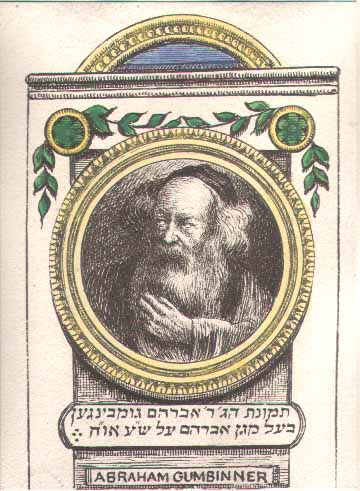
(A likeness of the Gaon, Rabbi Avraham Gombinner the author of Magen Avraham on Shulchan Aruch Orach Chayyim)
PART I
Years ago, when we first embarked on the cemetery project, I was describing the plan to a friend here in London.
“Gombin,” he mused. “Gombin? I know that name. Ahah! Of course! The Gombiner Rov, The Magen Avraham. I read him every day!”
So who was the Gombiner Rov? Why was he called the Magen Avraham? Why was my friend exposed to him on a daily basis?
The Torah, Jewish Law, is divided into the Written Law (the Five Books of Moses) and the Oral Law. For over a thousand years the Oral Law was transmitted by word of mouth. Towards the end of the second century c.e., out of concern that persecution and expulsions would lead to it being forgotten, it was committed to writing in the form of the ‘Mishnah’. Over the next few centuries the Mishnah was discussed at length in academies in Babylon and Palestine. Notes of those debates are contained in an extensive work known as the ‘Gemorrah’ (conclusion). Taken together, Mishnah and Gemorrah are known as the ‘Talmud’.
Today, nearly two thousand years since it was first written down, the Talmud remains the primary text for students of the Torah. Rabbis, Scholars and Yeshiva Students immerse themselves in it. Hundreds of thousands of Orthodox Jews all over the world ensure that, at the very least, they study a small part every day.
The monumental nature of the Talmud (it combines a host of disciplines including law, history, philosophy, medicine and astronomy) has a particular drawback. If you want to access quickly, and in a digestible form, the rules (the ‘Halacha’) on a particular topic, the answer rarely jumps off the page. Instead you get the debate, the range of opinions expressed and the reasoning behind them.
In time, the need arose for a codified summary of normative law. Alfasi, Maimonides and the Tur (Ya’akov ben Asher), to name but a few, all produced codifications but for our purposes we will fast forward to the 16th century c.e. to a book called the ‘Shulchan Aruch’ (the Set Table).
The Shulchan Aruch is Judaism’s pre-eminent legal codification. It borrows heavily from the earlier codes mentioned above. It was written in Tsefat, Northern Israel, by Rabbi Yosef Caro and concluded in 1563. It was published in Venice, Italy, two years later.
Caro was a Sephardi, from a community of Jews expelled from Spain in 1492. Ashkenazi Jews, from Central and Eastern Europe, had their own customs and traditions, as well as (in places) different interpretations of the Halacha. It fell to Caro’s contemporary, Rabbi Moshe Isserles (known as the ‘Rema’), from Krakow in Poland, to insert into the Shulchan Aruch those instances where Ashkenazi practice was different. He did so in a work known as “HaMapah” (The Table Cloth).
The Shulchan Aruch is divided into four sections. One of them, Orach Chayyim, deals with the laws of prayer and festivals. A century after Caro and Isserles, a commentary on this section emerged from Kalisz in Poland, in a book entitled “Magen Avraham”, That book was the work of Avraham Abele ben Chayim Halevi, Gombin’s most famous son.
In short the work entitled ‘Magen Avraham’ is the primary commentary on the leading codification of the laws of prayer and festivals applicable to Ashkenazi Jews. Any Ashkenazi scholar investigating those laws would first read the main text in the Caro’s Shulchan Aruch, incorporating the Rema’s gloss, and then turn to the work of the Gombiner Rov for further elucidation. That is why my friend reads him every day!
Abraham Abele ben Chayim HaLevi was born in or about 1633 (some say 1637) in Gombin. His father was the Rabbi in Gombin. He was considered to be an illui, a child prodigy. His parents were slaughtered in Gombin, by Chmielnicki’s thugs, while he was still a youth. He then went to live and study with a relative in Lithuania, Jacob Isaac Gombiner. Later he became a Rabbi in Kalisz, Poland where he was known as the ‘Gombiner Rov’. He died in 1682 or 1683 and he is buried there.
The Rov began writing his commentary in 1665 and he finished it in 1671. The book was originally called Magen Avraham (Shield of Abraham). The author’s name was, of course, Avraham but the title is also a reference to the concluding words of the first blessing of the Amidah prayer. However, there was opposition to that title because Magen Avraham is also one of the names used for G-d. The commentary was renamed, temporarily, Ner Yisroel ("Lamp of Israel").
The Gombiner Rov’s brother, Yehudah, travelled to Amsterdam in 1673 to print the work, but died on the journey and the project lapsed. Eventually, in 1692, 10 years after the Rov’s death, the book was published by his son. The son wanted to perpetuate his father's name so he returned to the title Magen Avraham. In the preface to the work, he wrote that his father was frequently sick and suffered pain and discomfort.
PART II
The Gombiner Rov used his extensive learning to reconcile the rulings of Caro and Isserles, though generally preferring the latter when no compromise was possible. His approach was remarkable for its insistence upon the preservation of religious customs of contemporary Poland, while incorporating some of the Kabbalistic traditions of Tsefat.
The Rov taught that customary practice (‘minhag’) should be maintained. The primary sources of Jewish law are of course the Written Torah and the Talmud (incorporating the Oral law). Other sources include the commentators of the medieval period and the codifiers. In addition to these, the Gombiner Rov stressed the importance of following customary practice. This was no innovation, it was a long-standing principle that customs should be respected. The Rov gave them special emphasis.
For example, dealing with the widespread practice of hiring gentiles to work for the community on the Sabbath (the Shabbes goy) he wrote, "they allow themselves to hire a Gentile under contract to remove the garbage from the streets, and the Gentile does the work on the Sabbath". It could be said that this practice contravenes the Fourth Commandment (that servants also must rest on the Sabbath day). The Gombiner Rov permitted the practice of employing a non-Jew to work for the benefit of Jews on the Sabbath, acknowledging that it had become customary to do so. He expressed the view that in a previous generation a Rabbi of high standing must have handed down this ruling, for the sake of the community. Since it had been incorporated into customary practice, it had become permissible (subject to a series of constraints which are beyond the scope of this article).
Whereas 16th-century rabbis noted the custom to celebrate a boy’s barmitzvah on his 13th birthday with a festive meal, the celebrations were limited. The Gombiner Rov codified that a bar mitzvah should be as elaborate as a wedding. The lavish barmitzvah affairs that we often encounter today might trace their origins back to his ruling.
The Rov observed the "consumption of tabak through a pipe by drawing the smoke into the mouth and discharging it". He taught that smokers should first make a brachah (blessing) over smoking (as they would over food or drink) as it was a type of refreshment.
He taught that aliyot, the calling-up of individuals to the reading of the Torah in Synagogues, should be handed out based on events in congregants' lives, such as marriage, birth and death, rather than always giving such honours to the scholars. He also held that women can count for a minyan (the quorum of 10) necessary for the reading of the Torah.
Perhaps the Rov’s most prominent legacy concerns the calculation of the timing of prayers and other rituals. The Jewish day is divided into 12 ‘hours’. Each ‘hour’ is one-twelfth of the daytime period, consequently its length will vary with the season (longer in summer, shorter in winter, particularly as you travel towards the poles). There are two approaches to calculating these hours. One approach (that of the Rov, in his Magen Avraham) reckons the day from first light until nightfall. The other approach (attributed to Rabbi Eliyahu ben Shlomo Zalman, the Gaon of Vilna) reckons the day from sunrise to sunset.
For rituals, which are prescribed in the morning, Magen Avraham's calculations will always be earlier than that of the Vilna Gaon. For rituals, which are prescribed in the afternoon or evening, Magen Avraham's calculations will always be later than that of the Vilna Gaon. Modern calendars print both timetables, opinions differ as to which approach should be followed.
The Gombiner Rov lived through a period of great turbulence for eastern European Jewry. The Cossack leader, Chmielnicki, emerged from the Ukraine in 1648 and launched into seven years of carnage and atrocity against Poles and Jews. It is reckoned that the same proportion of the Jewish population was wiped out in this period, as perished in the Shoah 300 years later. The Yiddish Nation was traumatised.
There were various responses. For example, the influence of the mystical Kabbalists in Tsefat began to spread. Elsewhere, false messiahs appeared, the most famous of whom was Shabbetai Zvi, promising redemption but failing to deliver.
Another response to the challenges experienced by this generation was the Baal Shem Tov, the founder of the Chassidic movement. His influence was destined to change the face of orthodox practice down to this very day.
In the shadow of such radical change, the Rov could be seen as a pillar of established tradition. Although he synthesized aspects of kabbalistic practice into his halachic scheme, and was bold in his promotion of customary practice even where it modified ancient prescription, in the final analysis he was an orthodox scholar who, despite much suffering in his short life-span, did not waver from the beliefs of his antecedents.
Yet the Gombiner Rov casts light on a contemporary phenomenon. The Chmielnicki massacres had an effect similar to the Shoah. A pall of gloom hung over the immediate survivors, many of whom clearly re-assessed their faith.
Post-Shoah there has been widespread theological debate. Many different views have been articulated. At one end of the spectrum, the ‘ultra’ orthodox have continued just as before. Their dress, their language, their lifestyle are evoke 17th century Eastern Europe. Close to them on the religious spectrum there has arisen a ‘modern orthodox’ movement, which has maintained rigorous standards of belief and practice but has opened its mind to contemporary philosophies (for example in relation to education and psychology) and has adapted to the contemporary milieu. Thus, and to my mind, the Magen Avraham was not only Gombin’s most famous child, he was modern orthodoxy’s most famous grandfather!

From Encyclopaedia Judaica, volume 7 page 766
GOMBINER RAV, ABRAHAM ABELE BEN HAYYIM HALEVI (c1637-1683), Polish Rabbi.
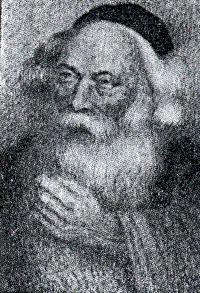
After the death of his parents during the Chmielnicki massacres of 1648, Abraham left his birthplace GOMBIN. In 1655 he went to Lithuania, and there studied with his relative, Jacob Jsaac Gombiner. Later he went to Kalisz, where he was appointed head of the yeshivah and dayyan of the bet din.
Abraham is best known for his Magen Avraham (Dyhernfurth, 1692), a commentary on the Shulhan Aruch Orah Hayyim, highly esteemed throughout Poland and Germany by scholars who followed it in their halakhic decisions, at times against the opinions of other codifiers.
In his work Abraham reveals his acumen, depth of insight, and comprehensive knowledge of the entire halakhic literature.
Abraham's main purpose was to reach a compromise bewteen the decisions of Joseph Caro and the glosses of Moses Isserles, but he upholds the latter where no compromise can be arrived at. He regarded all Jewish customs as sacred and endeavored to justify them even where they were at variance with the views of codifiers.
He also thought highly of the Zohar and of the kabbalists Isaac Luria and R. Isaiah Horowitz, occasionally accepting their decision against that of the codifiers. Magen Avraham is written in a terse style, which sholars were at times hard put to udnerstand until the appearence of R. Samuel Ha-Levi Kolin's extensive commentary: Mahazit ha-shekel.
Abraham is also the author of Zayit Ra'anan (Dessau, 1704), a commentary on the Yalkut Shimoni, published together with some of his homilies on Genesis, Shemen Sason. Zayit Ra'anan was also published in abridged form in the margins of the Yalkut, in the 1876 edition and in all subsequent editions. His short commentary on the Tosefta of Nezikin was published by his grandson under the title Magen Avraham at the end of the Lehem ha-Panim (Amsterdam, 1732) of his son-in-law, Moses Jekuthiel Kaufmann.
A commentary to Job, Proverbs, and Ecclesiastes was attributed in error to him, having in fact been from the Beit Avraham of Abraham b. Samuel Gedalia.
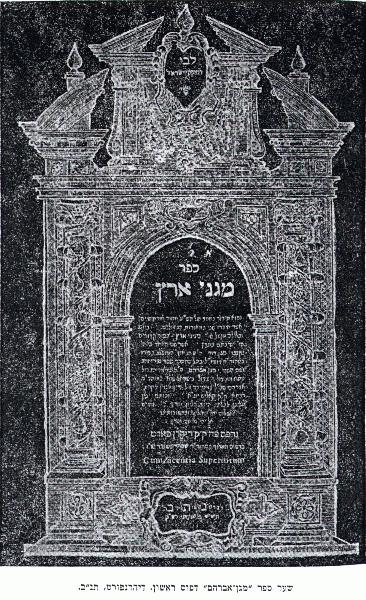
"Magen Avraham" - Cover Page, First print. Dyhernfurth, 1692
Return to Ada's Home Page ZCHOR

First posted on April 1998 - last updated October 9th, 2011