|
Appendix: Albania |
|
413 |
|
Index of Names |
|
425 |
|
Index of Places |
|
447 |
|
English Preface |
|
VII |
|
English Abstract of the Introduction |
|
IX |
|
Maps: |
|
|
|
Jewish Communities and Settlements in Greece |
Between page
ז and page 1 |
|
"Old Greece" and Borders of Modern Greece |
Between page
12 and 13 |
|
Jewish Communities in Occupation Zones |
Between page
32 and 33 |
|
Salonika during World War Two |
Between page
272 and 273 |
|
Jewish Communities and Settlements in Albania |
Between page
412 and page 413 |
PREFACE
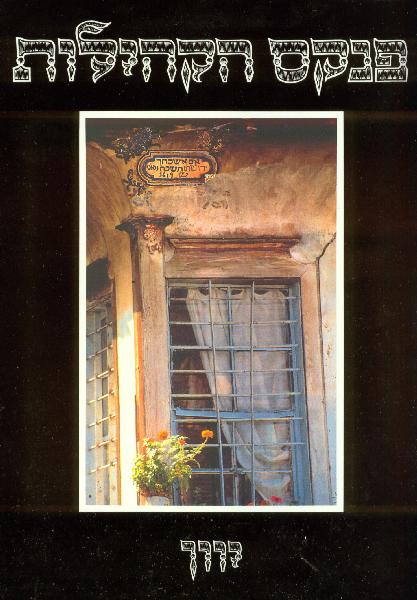
This volume of Yad Vashem' 5 series Pinkas ha-Kehilot (Encyclopaedia of
Jewish Communities from their Foundation till after the Holocaust), which
aims to set up a memorial to European Jewry, portrays the Jewish presence in
Greece from its early beginnings until its near total destruction during the
Holocaust.
Structure of the book and the entries.
The Encyclopaedia of Jewish
Communities: Greece opens with an historical introduction that covers the
history of the Jewish community in Greece from its early beginnings until the
present, with particular emphasis on the period between the Balkan Wars and
the Second World War, as well as the events of the war itself. A selected
bibliography follows the introduction. The entries in this volume, as in the
other volumes of the series, appear in alphabetical order; the name of each
community is given in Hebrew and English, and additional names, as they appear
in various sources are given in parentheses, along with the Greek name.
Historical sites and ancient communities appear, in brief, along with entries
about settlements with no clear evidence regarding an organized community.
Most entries include a table of statistics, that has been compiled from
various sources. Official censuses held in Greece in 1928 and 1940 offer the
basic statistical data about the Jews in Greece during the inter wars period.
Each entry opens with brief background on the location of the community,
followed by a chronological description of the history of the Jewish
community. Larger entries are subdivided by topic. The period prior to the
Holocaust, as well as the Holocaust itself, are dealt with extensively if the
sources allow this. Each entry concludes with a brief survey of the
whereabouts of the Jews of the community since the Holocaust, followed by a
bibliography and the author's initials.
This volume includes four maps of Greece and an appendix about the Jews in
Greece's northern neighbor, Albania (along with a map). Although Albanian
Jewry was a tiny community on the eve of the Second World War, they maintained
a tradition of deep and close ties with Greek Jews. The occupation of Greece
by German troops came after bloody battles fought in Albania. Nevertheless,
whereas the Jews of Greece were deported to gas chambers, Albania became a
haven for Jewish refugees.
The Encyclopaedia of Jewish Communities: Greece is based on various
sources: The Rabbinical Responsa Literature, archival material, testimonies,
journals and historical research. All these sources include the names of
places and personalities in a variety of languages:
Turkish, Greek, Italian, Ladino and Hebrew. In most cases, the names used are
those appearing in the sources, with an indication of the present names. The
index listing places and personalities at the end of the book is intended to
help the reader to locate topics of personal interest.
Acknowledgments. I wish to convey my deepest thanks to all those
who assisted me in the preparation of this book, in Greece and in Israel:
institutions such as archives, libraries and museums, as well as individuals.
The cooperation and encouragement of Israelis of Greek origin at all stages of
the project is worthy of deep appreciation and admiration. In Greece this
project received the full cooperation of the Central Board of the Jewish
Communities in Greece, the Jewish Museum in Athens and the Presidents and the
Boards of the Jewish communities in Salonika, Volos and Athens.
I wish to thank Dr. Jacques Stroumsa and Mr. Zvi Loker, who were active at the
inception of the project, as well as Mr. Itzchak Kerem and Dr. Lea
Bornstein-Makovetsky who wrote several entries. I am appreciative of the
assistance rendered by members of the Association of Survivors of
Concentration Camps of Greek Origin living in Israel and their chairman Mr.
Raul Sapporta, members of the Israeli Second Generation of Greek Survivors of
Death Camps, as well as members of the "Hellas-Israel League". Their advice,
criticism, actual help in translations of articles, as well as in directing me
to various sources, has been invaluable. I owe a special debt of gratitude to
several colleagues, especially Prof. Steven Bowman of the University of
Cincinnati and Robert Attal of the Ben-Zvi Institute, who helped the project
from its inception. I appreciate the support and encouragement from Greece: In
Athens, Dr. Yorgos Haniotis, Rabbi Yaakov Arrar, Dr. Nicholas Stavroulakis,
former director of the Jewish Museum of Greece in Athens and Zanet Battinou,
the Museum's curator, Abraham Minos Sasson and Nissim Mais, President of the
Central Board of Jewish Communities in Greece. In Salonika, Andreas Sefiha,
President of the Jewish Community of Thessaloniki, the Board of Directors and
Shelly Cohen-Karmi. In Corfu, Milka Toya. In Israel, I am especially indebted
to Dr. Immanuel Margalit, Rabbi Efraim Levi, Rabbi Dov Ha-Cohen, Yaron
Ben-Naeh, Renato Spiegel of the Central Archives for the History of the Jewish
People, Arieh Koretz, Prof. Samuel Hassid, Artemis Miron, Moshe Ha-Elion,
Delia Cohen, Rivka Fishman, Gavra Mandil, Hayyim Cohen, Jacqueline Benatar and
Jack Handeli, as well as grateful to Yitzchak Kerem, Yaakov Weiman, Ilan
Karmi, Yoram Goren, Neta Gatenyo, Berry Nahmias, Intu Shimshi and Stella
Jakoel, who lent me photographs from their private collections.
My thanks to Mr. Avner Shalev, Chairman of the Directorate of Yad Vashem, Dr.
Shmuel Spector, director of the Encyclopaedia of Jewish Communities,
and Bracha Freundlich, the devoted coordinator of the department. I also thank
all my colleagues at the Yad Vashem library, Archives and department of the
Righteous. Last but not least, I am grateful to Hanna Stern who prepared the
manuscript for printing.
Dr. Bracha Rivlin
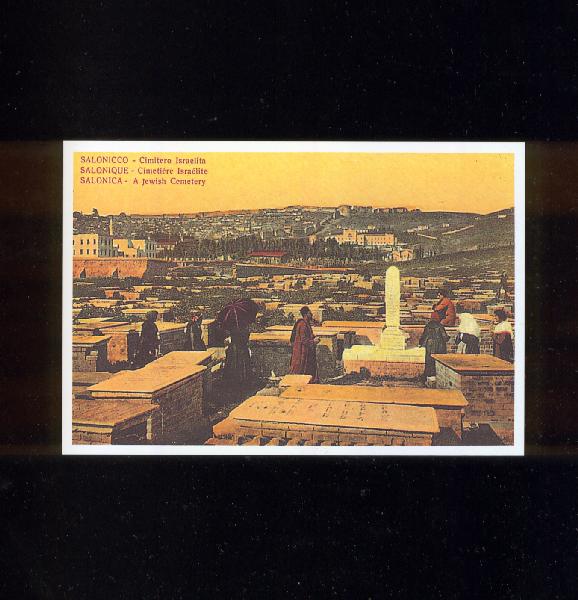
Dr. Bracha Rivlin
HISTORY OF THE GREEK DIASPORA - ABSTRACT
On the eve of World War II, some 80,000 Jews lived in thirty-one communities
in Greece. By far the largest and best known was Salonika, a Jewish metropolis
since ancient times. Seventy thousand Jews, or 87 percent of Greek Jewry,
perished in the Holocaust. Only 10,000 persons survived. Today the Jewish
community in Greece is estimated at about 5,000.
The roots of Greek Jewry stretch back to antiquity. An early inscription
attests to a Jewish presence in Greece in the third century B.C.E., but it is
very likely that Jews moved there either by force or as a result of travel
during the Biblical period. In the aftermath of the Hasmonean uprising, when
many Jews were sold into slavery, the community expanded. In the second
century B.C.E. Jews are mentioned as residing in Sparta, Delos, Samos, Rhodes,
Kos, Chios, and Crete. The record of Jewish settlement in Salonika, which was
to become the largest and most famous Jewish community in Greece, begins
around 140 B.C.E.
It appears that during and after the Jewish War (66-70 C.E.), the Jewish
population of Greece grew considerably. Josephus relates, for example, that
the victorious Roman Emperor Vespasian sent some 6,000 Jewish young men from
Palestine as forced laborers to dig a channel at the Isthmus of Corinth.
Early on the Jews in the Greek Diaspora adopted the Greek language (retaining
Hebrew for liturgical purposes) and used the famous translation of the Bible
known as Septuagint, compiled in Egypt in the third century B.C.E.
The Byzantine Period (330-1204)
The split of the Roman Empire into the Eastern and Western parts and the
transfer of the capital to Constantinopole in the fourth century C.E. marked
the beginning of the integration of Greek national history with that of the
Christian Orthodox Church. This had profound consequences for the Greek-Jewish
Diaspora.
Following the fall of Syria, Palestine, and Egypt, and, after 644, with the
completion of the conquest of the Persian Empire (including Babylonia) by the
Arabs, most Jewish communities in the world found themselves under Arab-Moslem
rule and influence. In the West, the existing Jewish communities in Anatolia,
the Balkans, and Greece now came into contact with Western communities,
particularly those of Italy in the ninth century, as the Byzantine emperors
added these territories to their dominion.
A series of anti-Jewish imperial decrees promulgated in the first centuries
after Constantine the Great (including the forced conversion decree by
Heraclius in 632 and a similar decree by Leo III in 721) proved ineffectual.
The Jews enjoyed relative prosperity and freedom from persecutions; with some
outward conversions notwithstanding. The legal status of the Jews (who were
called "Romaniotes") in communal and religious affairs continued to be
recognized, and their legal inequalities consisted mainly of exclusion from
service in the armed forces and the government. In religious matters Hebrew
remained the language of the Jews, with some incursions of the Greek into the
liturgy. Their unique rite was called "Minhag Romania". In the tenth
century Karaism made its appearance. Little is known about writings that might
have existed in the areas of Midrash, Talmud and halakhah.
Benjamin of Tudela, the twelfth-century Jewish traveler, recorded Jewish
communities in Corfu, Arta, Corinth, Thebes, Chalcis, and in the islands of
Lesbos, Chios, Samos, Rhodes, and Cyprus, among others; he also left a
detailed and reliable account of the Jewish community in Constantinopole.
During the Byzantine period the largest community was that of Thebes (with
2,000 Jews according to Rabbi Benjamin), which also gained a reputation as an
important center of Torah study. Salonika was home to 500 Jews. The Jews of
Greece engaged in dyeing, weaving, and producing silk garments. In most of
these communities the ancient communal structure prevailed: it consisted of a
rabbi (known as Rav GadoI), the parnas Naggid, and Maskil
(community heads).
Overall, during the last 250 years before the Fourth Crusade, Jews in the
Greek part of the Byzantine Empire seem to have enjoyed a relatively peaceful
existence, due mostly to either the absence of, or inefficacy of the attempts
made to convert them.
The Fourth Crusade and the Late Byzantine period (1204-1453)
With the fall of Constantinopole at the hands of the Crusaders in 1204, the
Byzantine Empire disintegrated into numerous territorial-political units.
These were largely under various West-European rulers (French, Italian, and
Spanish), but included also Slavs, the Byzantine emperors, and the Ottoman
Turks. The community of Thebes remained the most important in Byzantium,
producing prominent rabbis, Torah scholars, and paytanim (liturgical
poets). Sizable Jewish communities existed also in Chalkis, Chios, Corinth,
Corone, Crete, Janina, Methoni, Misitra, and Patras. The local Romaniotes
absorbed Ashkenazi as well as Sephardi Jews into their midst.
In the late fourteenth century, with the expulsion of the Jews from Spain,
and, later, from Portugal and Sicily, Jewish refugees immigrated to Greece,
bringing with them the Sephardi customs and language. They formed the nucleus
of the Sephardi communities that would come to dominate the Greek Diaspora. In
addition, Jews from southern Italy settled in Corfu.
The Ottoman and Late Venetian rule (1453-1821)
During the Turkish (and late Venetian) rule, which lasted from the fall of
Constantinopole at the hands of the Ottomans in 1453, until Greek independence
in the early nineteenth century, the Jews paid a heavy price for the struggle
being waged between the Ottoman Empire and Venetian rulers over Greek lands.
The Jewish communities of Patras, Thebes, Corone, Methoni, Chalcis, and
Naupaktos were destroyed; only a handful of the ravaged communities were
rebuilt. The policy of large-scale resettlement pursued by the Turks in the
newly conquered lands led to massive emigrations. The result was the serious
depopulation of Jewish Greek communities and the undermining of their
traditional structure. Only the waves of immigration from the West helped some
of them recover.
The impact of the refugees' homeland and its culture - especially those from
Spain and Portugal - proved to be lasting and deep. Salonika became a melting
pot. Between the sixteenth and eighteenth centuries it developed into the
largest Jewish community in Greece and a center of Torah learning; until the
early twentieth century it was populated by a majority of the Greek Diaspora.
The Sephardi heritage left its mark on every facet of Jewish life -
institutional, religious, cultural, economic, and social. The merchants of the
Patras community were known for their wide-ranging travels, whereas Thebes and
Crete gained fame as the home of scholars, sages and rabbis. Among the
prominent religious figures during the sixteenth and seventeenth centuries
were Samuel di Medina (Rashdam), Joseph Taitatzak, Benjamin ben Mattathias and
Samuel Kalai of Arta (the author of Mishpetei Shemuel). The Responsa of
these rabbis were accepted as the proper interpretation of the halakhah
throughout the Sephardi world.
During the Turkish period the Jews engaged in international trade (owing to
their connections and command of languages) with Italy, France, Amsterdam,
Hamburg, and, in the East, with Constantinopole, Izmir, and Alexandria. The
main crafts of the Jews of Greece were spinning silk, weaving wool, and making
and dyeing of cloth, but they also engaged in commerce, money-lending and
tax-leasing. A minority engaged in agriculture.
In the Greek islands under Venetian rule, the Jews could engage only in retail
commerce, whereas under Turkish rule they all but dominated wholesale trade.
In Thessaly, the Peleponnesus and the Balkans, however, the Jews lived in
extreme poverty, seeking out an existence by tinsmith's work or peddling. In
Salonika the port was closed on the Sabbath and Jewish festivals, as the Jews
practically monopolized the harbor economy.
The refugees from the Iberian Peninsula, particularly the Marranos, made their
influence deeply felt in many areas of Jewish life, including the economy,
commerce, liturgy, as well as customs (weddings, inheritance and ritual
slaughter) and language (Judeo-Spanish, known as Ladino). The messianic
movement of Shabetai Zvi (who resided in Salonika in 1651-1654, after his
expulsion from Izmir) swept the Jews of the city from all walks of life. A
large-scale voluntary conversion to Islam by some 300 families (called
Donme), including influential and affluent Jews, prefigured the deep
crisis that was to engulf the city's Jewish community in the eighteenth
century, following the collapse of the textile trade and the political chaos
in the region.
From Greek Independence to World War II (1821-1940)
The bloody, ten-year-long Greek revolt, which broke out in Peleponnesus in
1821, brought destruction and suffering to the ancient Jewish communities,
mainly due to their traditional pro-Ottoman sympathies. The most tragic was
the massacre of 5,000 Jews in the Peleponnesus; the remaining survivors fled
to Corfu. Anti-Jewish riots, disturbances, and blood libels (in Rhodes,
Thessaly, and Corfu, among others) prompted Jews to flee or emigrate abroad or
to areas still under Turkish rule, such as Salonika. By the end of the century
the Jewish population had dwindled to 10,000 - 5,000. Only after the end of
the Balkan War (1912-1913), which resulted in the annexation of further
territories (Salonika, Chios, Crete, among others) to the nascent Greek state,
did the Jewish population grow to 100,000.
The Jews' civic and political equality was officially recognized with the
establishment of the Greek State in 1821; in 1882, legal status was accorded
to the Jewish communities. In the capital of Athens the organized Jewish
community came into being in the mid-nineteenth century; it grew in size and
influence, absorbing numerous Sephardi immigrants from Izmir, Istanbul, Chios
and other Aegean islands. With the territorial expansion of Greece in the
nineteenth century, further communities came under Greek rule, especially in
Thessaly and Epirus. In areas still under Turkish rule, the community of
Salonika rose to a central position, with more than 17,000 Jewish families
living there in the last decade of the nineteenth century. Jews were active in
trade, banking, and industry; they operated flourmills and breweries and
entered into municipal services. Growing modernization left its imprint also
on internal Jewish life: a modern educational system was established, based on
linguistic, scientific and technical studies; a network of schools run by the
Alliance Israelite Universelle, or Kol Israel Haverim society, also
engaged in vocational training; and numerous newspapers, libraries, clubs, and
associations sprang up.
After the Balkan wars, the increases in the Greek population as a result of
the country's territorial expansion and the population exchanges with Turkey
brought about a lower percentage of Jews in the general population,
particularly in Salonika, where it dropped to 16.4 percent. This, in turn, led
to a gradual decline in the Jewish predominance of the city. The Greek
government's policy of systematic hellenization was aimed, among other things,
at the cultural assimilation of the Jewish minority. Also, economic
competition from new arrivals and legislation designed to protect the economic
position of the Greeks caused a deterioration in the Jews' economic fortunes.
By the 1928 census nearly all Greek Jews, a total of 73,000, were living in
the cities, with the overwhelming majority (83.5 percent) in Salonika. The
other most populous communities were Kavala in Macedonia (2,165 Jews), Janina
(1,970), Corfu (1,820) and Athens (1,578). The majority of Jews (62,000)
declared the Judeo-Spanish (Ladino) language as their native tongue, with only
10,000 declaring Greek.
The affluent Salonika Jews included bankers, jewelers, physicians, lawyers,
merchants, and trading, insurance and shipping agents. The Jewish proletariat
was concentrated in the tobacco and silk industries, harbor facilities, and
shipyards. Over all, the economic situation of the Jews in the city was not
particularly sound: in the mid-1930s Jewish welfare authorities reported that
nearly 60 percent of the community lived in conditions of serious economic
distress.
The law of 1920 established that in localities with at least twenty Jewish
families a community could be formed and assume authority in the areas of
religion, education, and social welfare. Communities could operate their own
schools with joint Greek and Jewish curricula. Each community drew up its own
statutes, and its assembly chose the rabbi and the committee responsible for
communal affairs, prayers, Jewish education, tax collection, etc. All in all,
twenty-four communities were accorded formal recognition in 1920.
The hellenization of Greek society as a state policy manifested itself during
the 1920s and 1930s in economic and political restrictions. As part of the
effort to force the Greek Jews to integrate into the general society through
language conformity, there were continuing demands to increase the share of
Greek language in the curricula of Jewish schools.
In 1924, despite vigorous protests from the Greek and international Jewish
communities, the law of Sunday rest was enacted and enforced. This forced
Jewish wage-earners to lose one workday each week and became a turning point
in the life of the Jewish community. Another law, in 1932, however, recognized
Jewish festivals as days of rest for Greek Jews. Ultimately, educational
instruction in the Judeo-Spanish (Ladino) language was banned by law in 1931.
From the beginning of the twentieth century, the Greek Jews' response to
cultural and economic restrictions was emigration. Successive waves of
emigration followed each political crisis. The great fire of 1917 in Salonika,
which devastated a significant part of the city, the population exchange with
Turkey, and the Sunday law were followed by the world economic depression.
These all affected the Greek Jews. A constant stream of emigrant Jews flowed
from Greece - to France, Italy, England, South America, the United States, and
Palestine.
Anti-Semitism in the pre-war period was mainly of an economic nature,
especially in Salonika, which had recently absorbed numerous Greek refugees
from Turkey, and where Jews held key positions in the city's economy.
Anti-Jewish riots in the Campbel section of the city broke out in 1931, with
the active instigation of the nationalist and anti-Semitic movement known as
the "triple epsilon" or EEE (Greek National Union). Many of their members were
Greek refugees from Asia Minor. Beside economic considerations, anti-Semitism
in Greece was fueled also by the rising tide of Anti-Semitism in Europe,
especially in Germany and the Jews were accused of disloyalty to Greece. In
1928, the Greek translation of The Protocols of the Elders of Zion was
published despite Jewish protests. Paradoxically, it was the dictatorial
regime of Metaxas (1935-1941) that clamped down on the Greek anti-Semites and
publicly affirmed the Jews' civic rights and their rightful place in the Greek
homeland.
|
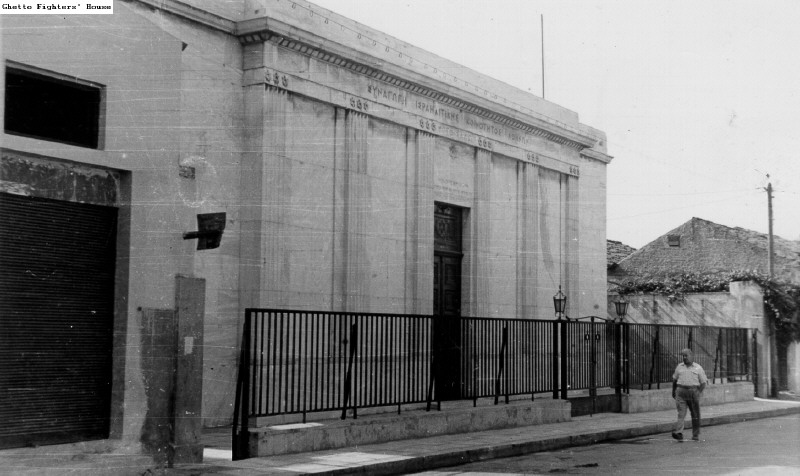
The Synagogue of Athens
(the Germans turned it into their headquarters)
(gfh
archive)
|
Jewish Communal and Public Lift after the Balkan Wars
The Sephardi communities concentrated in the north of the country, especially
in Salonika, maintained an extensive network of institutions, organizations
and associations - mostly Zionist - in every sphere of public life. Zionists
were also dominant in the governing bodies of the Salonika community.
Religious life also flourished with nearly forty active synagogues on the eve
of World War II. Other, though smaller, predominantly Sephardi communities
existed in Komotini, Didimoticho, Ksanti, Kavala, Kastoria, Seres, and Veria.
During the Turkish-Ottoman rule a great many ancient Romaniote-Greek
communities disappeared, but they left behind multi-lingual piyyutim
(religious poetry) in Hebrew, Greek and Italian. In the Epirus region the
ancient Romaniote community of Janina numbered nearly 2,000 Greek-speaking
Jews. On the Greek mainland the largest Romaniote community was in Athens
(originally established by Ashkenazi Jews); an old Romaniote synagogue has
survived to this day at 8 Melidoni Street. Other, small Romaniote communities
existed in Larissa, Volos, Trikala, Chalcis, Patras, Corfu, and Crete. In
addition, small congregations of Italian-speaking Jews (descendants of
refugees from Sicily and southern Italy) existed in Patras and Salonika, among
others.
|
Jewish Cultural Life
Under the impact of the spirit of the Enlightenment, which made itself felt
from the mid-nineteenth century, and the growing exposure to the West, Greek
Jews developed a modern culture of their own in journalism, theater, music,
literature, as well as science. The main vehicles of this cultural renaissance
were the school system, traditional as well as modern organizations and
institutions, social clubs, youth movements, Zionist and socialist political
associations, theater, music, and sport societies. Side by side with the
flourishing religious literature that was continually published and reprinted
(Eyn Ya 'acov, a collection of sixteenth century Talmudic tales and
legends, went through more than 100 editions), secular Jewish literature in
Judeo-Spanish (Ladino), French, Greek, and Hebrew was being produced, mainly
by writers concentrated in Salonika. The greatest Jewish poet writing in
Greek, Yossef Eliyah of Janina, translated poems of Rabbi Yehuda Halevi, Ibn
Gabirol, as well as Bialik and Tschernikhovsky from Hebrew into Greek. Growing
public interest in foreign secular literature resulted in translations of over
150 novels from various European languages into Judeo-Spanish (Ladino).
Zionist literature, such as Herzl's Altneueland, was also translated.
Jewish theater came into its own, plays were staged with amateur acting
ensembles in indigenous productions as well as in translated works (Racine's
Esther was especially popular.)
In the interwar period there was also an unprecedented boom in the Jewish
press, principally in Judeo-Spanish (Ladino), but also in French and Greek;
some of the newspapers were bilingual. Between 1900 and 1936 five dailies in
French were published in Salonika; nearly all the other Jewish dailies and
periodicals also originated there. Although some were published irregularly
and reached only a limited circulation, the publications ranged from
ideological organs of political movements to community-oriented, cultural, and
humorist papers covering a wide range of public Jewish interest.
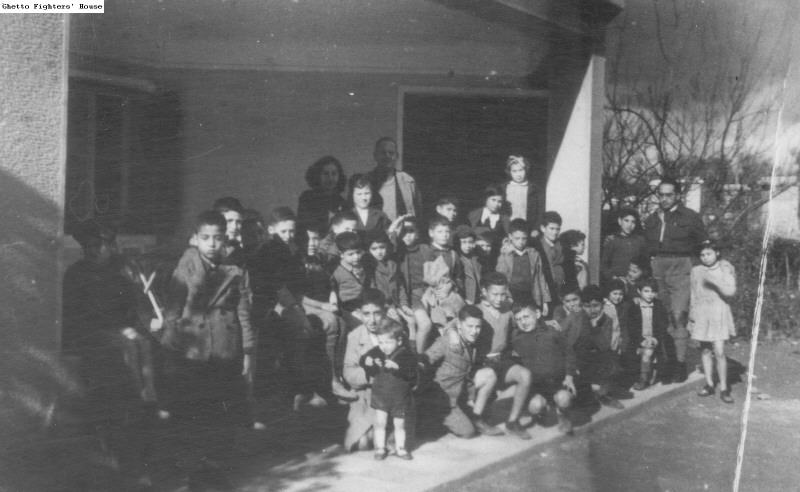
Orphanage near Athens
(gfh archive)
The Zionist Movement in Greece
From its modest beginnings in 1908, when the Young Turks movement made
possible the emergence of the first Zionist organization in Salonika, the
Zionist movement in Greece entered its golden era after the incorporation of
Salonika into Greece following the Balkan Wars. Vigorous and dynamic from the
outset, Zionist activities encompassed fund-raising for the Jewish National
Fund, Hebrew lessons, public lectures, special events such as the "Shekel Day"
and "Hebrew Day", as well as diverse political activities, including elections
to the Parliament, the city hall and the community's governing bodies. After
the Balfour Declaration, all Zionist associations in Salonika joined forces as
one single club called "Theodor Herzl". The first anniversary of the Balfour
Declaration was celebrated by a gathering of some 30,000 Jews in Salonika. In
1919, in a speech by Foreign Minister Nicolas Politis, the Greek government
expressed its sympathy for the movement. On June 10, 1919, an assembly of all
Zionist associations in the country established the Greek Zionist Federation,
headed by Dr. Moshe Cofinas. Beside Salonika, Zionist organizations were
active also in the communities of Athens, Kavala, Drama, Larissa, Volos, Arta,
and Corfu, among others. Somewhat less extensive Zionist activity took place
also in the recently recovered Thrace region. Several prominent Zionist
leaders (David Ben-Gurion and Menahem Ussishkin, among others) visited
Salonika and spoke to enthusiastic audiences of thousands.
Greek immigrants to Palestine shipping agents, shipyard workers, bankers,
merchants, industrialists, journalists and writers - left their distinctive
imprint on the Yishuv. Along with others, they were among the founders
of several Tel-Aviv city neighborhoods and played key roles in developing the
shipyard infrastructure and harbor facilities in Haifa, as well as in the
development of the local tobacco industry.
Despite the numerous difficulties that besieged the Zionist movement in Greece
(separatist tendencies within the Federation, splits, emigration of prominent
leaders and activists to Palestine, police and lower official harassment,
British complaints about illegal immigration), it carried on, especially in
the area of fund-raising. However, during the last years before the occupation
of Greece by the Germans, the Zionist movement practically ground to a halt,
and the attempts to unite the various organizations within a single federation
failed.
The Holocaust Period
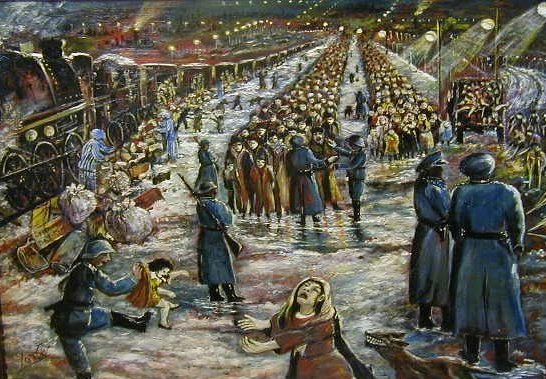
Moshe Matarasso: Arrival at
Birkenau. Mothers and children separated from their fathers. Old and
handicapped people to the right .The first selection starts.
Despite the successful resistance of the Greek armed forces against the
Italian invaders late in 1940 and early 1941, the Germans succeeded in
occupying the country, by entering from Yugoslavia and Bulgaria, in April
1941. Jewish soldiers took an active part in the battles against the Italians;
one estimate put the number of Jewish servicemen at more than 12,000,
including 350 officers. The best known was Colonel Mordekhai Frizis of
Chalcis, who fell in battle in December 1940; his heroism was commemorated by
the Greek people who named twenty-nine streets after him in their towns and
cities.
Despite reinforcements from the British contingent, the Germans completed
their occupation of the country with the conquest of Crete. Soon thereafter
Greece was divided into three occupation zones: German (eastern Thrace,
central and eastern Macedonia, including Salonika, and Crete); Italian
(central Greece, including Athens, the Peleponnesus, sections of the western
coast and the Ionian Islands, Kastoria, Chalcis, Patras, and Janina), and the
Bulgarian (western Thrace, eastern Macedonia, including Kavala, Seres, and
Drama, among others). The Bulgarians were rewarded for joining the Axis. A
Greek puppet regime was installed in Athens.
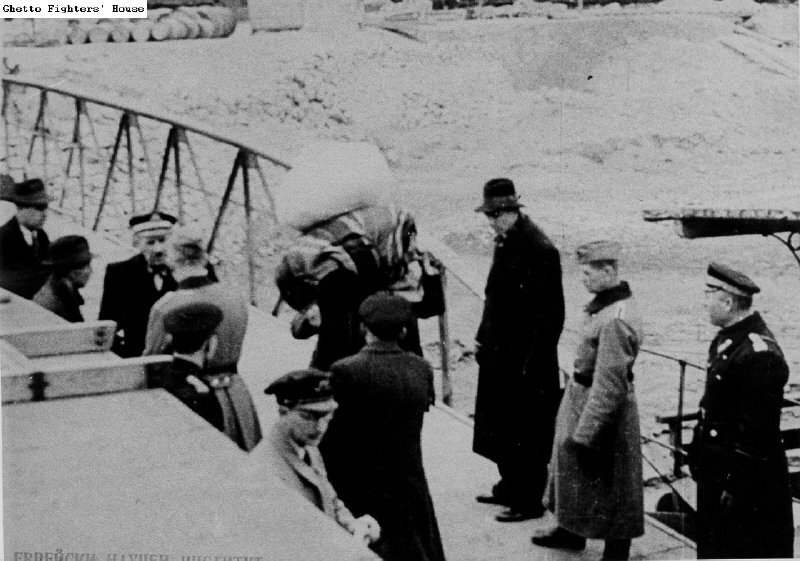
Deportation to Trablinka
(gfh archive)
Immediately after the occupation, German actions against the Jews began. In
Salonika, in the German occupation zone, anti-Jewish measures were introduced
immediately after the German troops entered the city in April 1941.
Jewish-owned apartments were confiscated; prominent Jewish figures were
arrested; communal and public organizations and institutions were liquidated;
and Jewish cultural treasures, especially valuable Hebrew manuscripts, were
looted. In July 1942, in what later came to be called "Black Sabbath", all
Jewish men were assembled in one of the city's squares and sent to forced
labor. The agony of forced labor stimulated efforts to release the men, and
shortly thereafter the Germans agreed to ransom them for 2.5 million (old)
drachmas. Later that year Jewish-owned businesses and factories, as well as
the ancient Jewish cemetery were confiscated. In February 1943 racial
restrictions were introduced. The ghettoization of the Salonika Jews in a
specially designated section of the city soon followed.
Eichmann's deputy R. Gunther and Himmler's assistant D. Wisliceny arrived in
Salonika in January 1943 to oversee the implementation of the "final
solution". Despite warnings from the Jewish underground of impending
deportations, only 3,000 Jews fled to Athens. The Baron Hirsch ghetto near the
railroad station was the transit point. The first transport of deportees left
Salonika for Auschwitz-Birkenau on March 15, 1943. A total of 48,533 Jews were
deported to the death camps in Poland in nineteen transports, about 3,000
people in each. More than 37,000 of these deportees were gassed immediately
upon arrival. The final, nineteenth transport, consisted of 1,800 starving
Jewish forced laborers. By August 1943, Salonika, the great center of Sephardi
Jewry in Europe, ceased to exist.
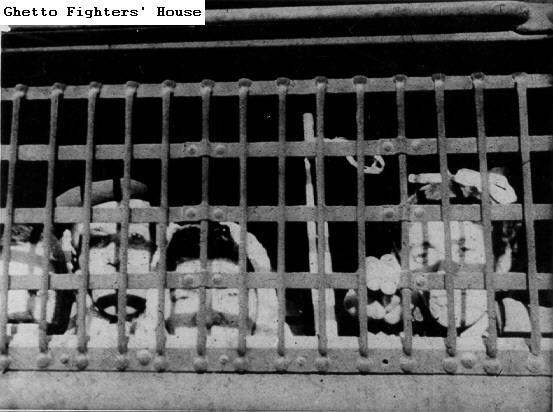
Deportation
(gfh archive)
Under Italian rule, in Athens and Peleponnesus, the Jews lived relatively free
of persecutions. After the Italian surrender in September 1943, however, the
Germans occupied the entire country and proceeded to implement the "final
solution" throughout Greece. Thanks to the concerted efforts of Greek
Archbishop Damaskinos to save the endangered Jews, as well as the help
extended by the underground movement, only 1,300 Jews were deported from
Athens to the death camps. Many Greeks throughout the country (but especially
in the Italian zone) offered refuge to Jews who asked for their assistance.
Nearly 200 Greeks from all sectors of society have been honoured as Righteous
Gentiles by Yad Vashem.
In the Bulgarian zone the authorities embarked on a program of Bulgarization,
just as they had done during World War I. Anti-Jewish measures were introduced
in August 1942, and hundreds of young Jews were drafted into labor battalions.
In March 1943, more than 4,000 Jewish men, women and children were assembled
in different locations in Thrace, deported to Bulgaria, and handed over to the
Germans.
The total number of Greek Jews who were sent to their death in the
extermination camps is estimated at 65,000, or about 85 percent of the entire
Jewish population of the country.
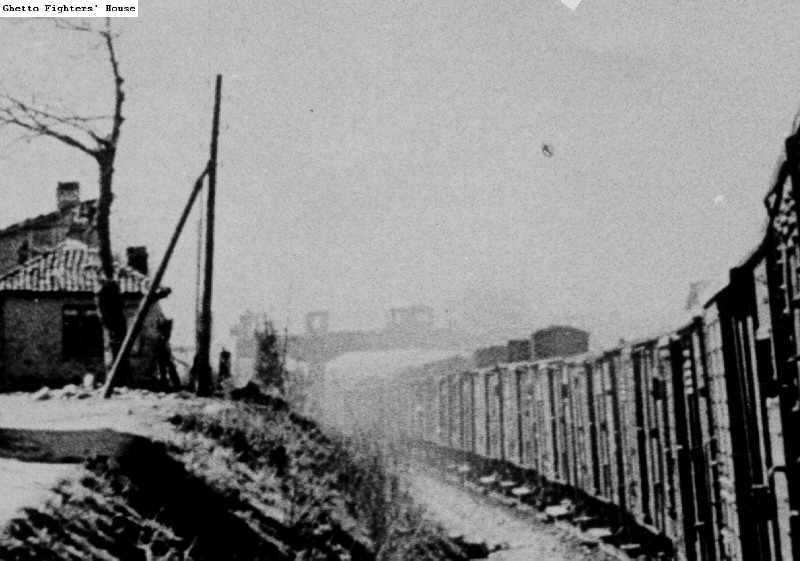
Train to
Treblinka
(gfh archive)
Jewish Partisans
During the German occupation, some 1,300 Jews joined the Greek partisans and
took part in guerilla warfare against the occupier; these included sabotage
operations, severing lines of communications, disrupting supplies, and
information gathering. Partisan units made up almost entirely of Jews operated
in Salonika, Athens and Thessaly under command of either Greek or British
officers. They established contact between the various parts of the country
and the Allied general headquarters in Cairo and gathered information on troop
movements and sabotage. Jewish partisans also hid hundreds of their brethren
in remote mountain areas and supplied those hiding in urban centers. Perhaps
the greatest single heroic act of the Greek-Jewish underground, however, took
place far away, in Auschwitz-Birkenau: 135 members of the Sonderkommando
who cremated the corpses of gassed Jews mutinied and blew up two crematoria.
They held out for one hour before all of them were gunned down.
The Postwar Period
For the 10,000 survivors left in Greece in the autumn of 1944, the
reconstruction of the Jewish community proved most difficult. This was mainly
due to the bloody civil war that raged for nearly five years, pitching
Communist guerillas against the government forces who were supported by the
British and the Americans. In 1959, the Jewish population was reported to
consist of 6,112 persons. Emigration to Israel was the main cause of the
dwindling community. By 1967 the Jewish population had risen to 6,500 persons
scattered among eighteen communities; the largest was that of Athens, with
2,800 Jews.
In addition to the consequences of the civil war, the economic crises, and the
ravages of the occupation, the restoration of Jewish life in the country also
ran into obstacles related to the restitution of lost property. The procedure
in the Greek courts and the bureaucracy was excruciatingly slow.
Over the years, however, the Jewish community slowly recovered. By the late
1960s the Jewish population had finally risen above subsistence level, thanks,
among others, to the material support of world Jewish organizations, including
the Joint and the Jewish Agency.
Jews began entering into various branches of the economy and assumed government
posts; later Jews also entered universities, the medical professions, and the
arts and mass media. Except for isolated incidents, Anti-Semitism in Greece was
on the decline.
At present Athens is the largest community. Others include Salonika, Larissa,
and Volos; with very small communities existing in Corfu, Janina, and Chalcis.
KIS, the central Jewish organization representing Greek Jews vis-a-vis the
authorities and world Jewish organizations, looks after Jewish interests in the
country, and remains in charge of educational and philanthropic activities. This
body also oversees abandoned synagogues in Greece and several projects
commemorating Greek Jewry in Greece and Israel.